
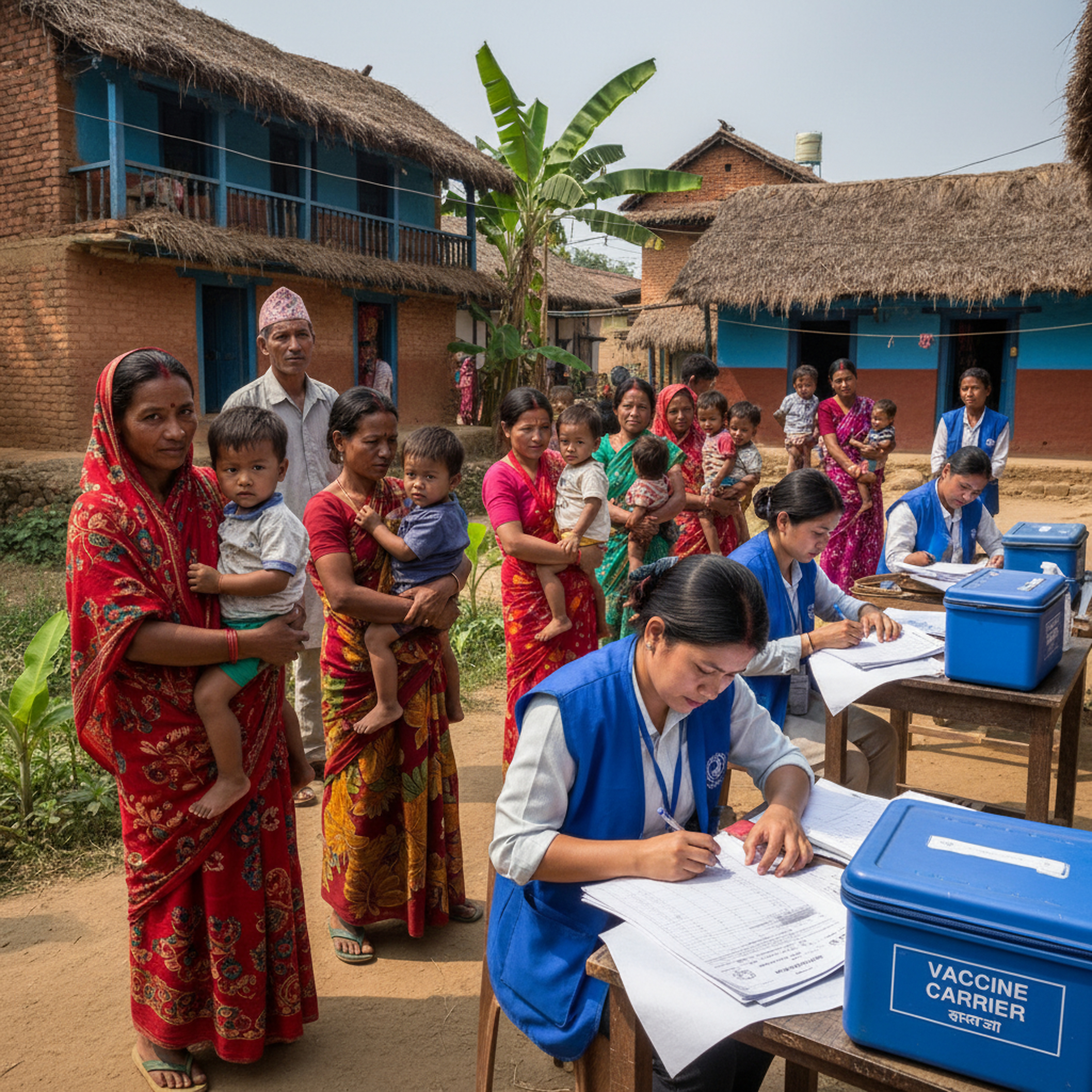
Sarlahi sits in the southern plains of Nepal where cross-border movement, seasonal labor, and dense settlements can turn a routine health alert into a fast-moving outbreak. When measles signals emerged there this year, the response moved at a pace that stood out. The World Health Organization described the containment as a case of early action, rapid coordination, and immunization drive execution that prevented a localized flare-up from becoming a wider emergency. That story is not only about a virus. It is about how public health systems win on speed, trust, and preparedness, and what it still costs when vaccine supply is tight and public confidence is fragile.
The immediate facts are simple. A measles outbreak was detected in Sarlahi, and the response sequence ran quickly: surveillance identified the cluster, coordination followed, and an outbreak response immunization (ORI) effort reached communities to cut the chain of transmission. That is the ideal model, but it only works when the field teams have transport, staffing, cold-chain stability, and enough vaccines to move fast. It also assumes that families are willing to open their doors, and that the information reaching households feels credible. Without those preconditions, even the best-designed containment plans can slide into delay.
For Nivaran, the case is not only news. It is a reminder that Nepal's health security is a daily practice, not a ceremonial policy. The lesson is practical: early detection must be built into everyday health care, not bolted on during crisis. Community health workers and local clinics are the first eyes and ears of outbreak response; they are also the first to feel the impact of shortages, staffing gaps, and logistical friction. The Sarlahi episode underscores how quickly the system can protect lives when these frontlines are supported, and how easily it could stall if they are not.
Why Sarlahi mattered
Measles is often described as a childhood illness, but that language hides the stakes. It is highly contagious and can be devastating in under-immunized communities, especially where nutrition is fragile or access to hospital care is distant. Nepal's geography alone makes that dangerous. When a contagious disease hits, the same roads that connect markets and families also carry infection. The southern plains have connectivity that speeds spread; the mountain districts have remoteness that slows response. Sarlahi is in the plains, which means a successful containment there is a signal that the response systems can move fast even in dense population settings.
WHO's reporting on the Sarlahi response emphasized how early action limited escalation. The response hinged on rapid coordination and a targeted immunization push. But what that public report does not need to explain, and what every health worker knows, is that success does not happen in the emergency alone. The readiness has to be prebuilt: refrigerators maintained, vaccines forecasted, transport budgets secured, and local data systems trusted. That groundwork is not glamorous, yet it determines whether an outbreak response works within days or dissolves into weeks.
The supply question that shadows every response
Just weeks before the Sarlahi response, Nepal's health ministry publicly asked development partners for measles vaccine support. That request was a warning about supply pressure in an immunization system that is otherwise known for its reach. It showed that speed in outbreak response is not only about field operations; it is also about steady procurement and buffer stock. When stocks are thin, a response becomes a redistribution exercise rather than an expansion of coverage. That is a dangerous pivot because it forces officials to choose which communities to prioritize, which inevitably leaves some families waiting.
The larger picture is that Nepal has made significant progress on vaccine-preventable diseases, including recent recognition from WHO for eliminating rubella. That achievement reflects decades of immunization work, but it also raises the stakes. Once a country approaches elimination targets, the cost of any outbreak rises because the window for re-establishing transmission narrows. In that context, a measles flare-up is not a routine headline; it is a stress test for a system that is trying to finish the last mile.
For communities, vaccine supply is not an abstract procurement line. It translates into whether a mother hears a radio announcement and then actually finds a dose available at the local health post. It shapes whether a father returns from work abroad and can trust that his children's immunization records are accurate. It affects whether a school head teacher can reassure parents that the classroom is safe when rumors spread. And once those rumors take hold, it becomes harder for anyone to move quickly.
Trust is the fastest form of logistics
Rapid response depends on more than stock and transport. It depends on trust. In outbreak work, the fastest way to deliver protection is to convince people that the intervention is real, urgent, and respectful. Nepal's community health volunteers and local clinical teams are often the most trusted messengers. They speak the language, know the community rhythms, and can answer concerns in real time. When the Sarlahi response moved fast, it was a product of those relationships as much as any protocol.
This is where health and education intersect. Health literacy is the quiet force that makes immunization campaigns succeed. A community that understands how measles spreads will act differently from a community that sees vaccines as optional or politically loaded. Schools can help build that knowledge early. Community radio can reinforce it. Local leaders can normalize it. The result is not merely better awareness; it is the ability to mobilize without friction when an alert comes in.
Nivaran's own programs sit at this crossroads. The Sanjeevani pathway focuses on mobile and last-mile health access, while Vidya addresses education barriers and community learning. Outbreak response is a living example of why those two pillars must be aligned. When education builds trust, health interventions travel faster. When health services are reliable, schools remain open and safe, and students keep learning.
What an outbreak response looks like on the ground
Outbreak response immunization is not a single event. It is a sequence: case detection, verification, risk assessment, micro-planning, vaccine delivery, cold-chain monitoring, community mobilization, and follow-up. Each step is a potential bottleneck. In Sarlahi, the timeline compressed because those steps were aligned and resourced. That alignment needs continuous investment, especially in the districts where health posts are under-staffed and transportation is unreliable.
Frontline staff can only respond quickly if they have the basics. That includes protective equipment, fuel budgets, and phone connectivity to report cases. It includes clear guidance on how to document suspected cases and who to notify. It includes a stable roster of personnel so the same health workers can build relationships over time. And it includes the political willingness to move resources immediately without waiting for a prolonged approval chain.
A successful response is also a data story. Nepal's surveillance system has improved over the years, but data gaps still exist. Some communities are still under-reported. Some symptoms are never documented. That does not mean those communities are safe; it means the system is blind there. The Sarlahi response is therefore a reminder that surveillance is only as strong as its weakest point. If one district is slow to report, the outbreak moves ahead of the response.
The education ripple
Measles outbreaks do not only strain clinics. They disrupt schools. Parents keep children home when rumors spread or when there is a confirmed case in the neighborhood. Teachers carry misinformation the same way communities do; they need credible updates and clear guidance. That is why the health sector cannot contain outbreaks alone. Education officials, school administrators, and local educators need to be part of the response plan, not an afterthought.
In Sarlahi, the speed of the response likely protected classroom continuity. That matters because Nepal's education system is still recovering from recent disruptions, and each closure deepens learning gaps. It also matters because school health is not a separate track; it is where large groups of children can be reached quickly for vaccination messages and catch-up schedules. When health and education work together, the result is a stronger shield around both.
The same logic is visible in Nivaran's recent reporting on civic education and the role of community mobilization. The recent Nepal news on civic education highlighted how fast large-scale awareness campaigns can move when they are locally rooted. Public health can borrow the same mobilization discipline: clear messages, trusted messengers, and a steady cadence of follow-up.
What comes next for Nepal's immunization push
Nepal's near-elimination of rubella, recognized by WHO, is a milestone that should be protected. It also shows that sustained immunization systems can achieve what once seemed impossible. But the measles response in Sarlahi is a warning that success requires constant maintenance. It is not enough to celebrate elimination achievements; the system must keep its edge.
That means funding vaccine procurement early enough to avoid last-minute gaps. It means protecting cold-chain infrastructure in the hottest months and the most remote districts. It means investing in community-level health workers, not only during outbreaks, but every day. It means continuous health education so the next emergency is met with readiness rather than confusion.
It also means building a feedback loop where local experiences inform national policy. If frontline teams report that a vaccination drive is slowed by a lack of transport, that should shape next quarter's budget, not wait for the next crisis. If rumors about vaccines are circulating in a district, communication campaigns should start before the outbreak hits. The health system's strength is measured in how well it anticipates, not only in how well it reacts.
For Nivaran, this is where mission becomes practice. A foundation that focuses on access, dignity, and outcomes cannot ignore the operational details of outbreak response. Supporting mobile clinics, community health training, and education outreach is not an auxiliary effort; it is a core protective layer. Every health camp that builds trust, every education session that increases health literacy, and every local partnership that improves reporting speed translates into faster containment when a disease appears.
A story about capacity, not luck
The Sarlahi response was not luck. It was capacity: data systems that identified the outbreak, teams that could mobilize, vaccine networks that could move doses, and community relationships that allowed households to say yes quickly. That capacity can be built and strengthened, but it can also be eroded. The difference is often measured in mundane choices-whether funding arrives on time, whether staff positions are filled, whether a broken refrigerator is fixed immediately or months later.
The message for Nepal is clear. Containment is possible. The Sarlahi experience shows that a fast, coordinated response can stop measles before it spreads widely. But it also highlights the cost of complacency. A single supply disruption or a single trust fracture can undo years of immunization progress.
In the months ahead, the country will keep working toward measles elimination targets while maintaining the gains made on rubella. The policy milestones are important, but the real work is in the day-to-day systems that protect children and families. That is where the story of Sarlahi belongs: not as a headline to archive, but as a reminder that public health is a living system that demands constant care.
If this story resonates, consider supporting the programs that make rapid response possible. Nivaran's work in health access and education is designed to close the distance between communities and care. You can learn more about the foundation's impact on health access and community support, and you can help sustain the momentum that prevents the next outbreak from gaining ground.
Your support helps Nivaran strengthen last-mile health access and outbreak readiness.
Support this work