Support frontline maternal health teams who bridge the gap between policy and survival.
Support this work

New WHO data confirms that instability is the primary driver of maternal death, with 60% of global fatalities now concentrated in fragile states. The biology of childbirth has not changed; the geography of survival has.
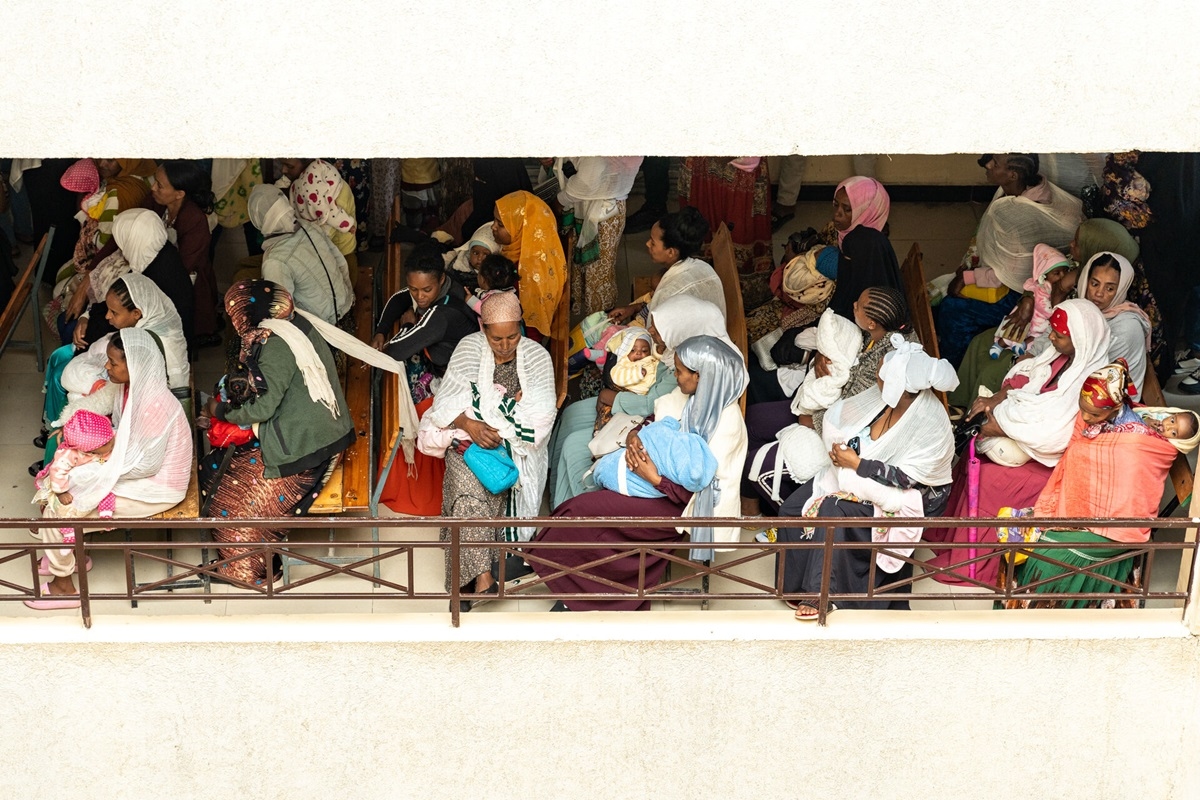
Mothers wait for essential health services at a clinic in Ethiopia. Credit: WHO / Addis Aemero.
Support frontline maternal health teams who bridge the gap between policy and survival.
Support this workOn February 17, 2026, the World Health Organization (WHO) released a figure that fundamentally reframes the global conversation on women's health: nearly two-thirds (60%) of all maternal deaths worldwide now occur in countries marked by conflict or institutional fragility.
For decades, the global health community has treated maternal mortality as a medical problem to be solved with better drugs, cleaner clinics, and more training. This new data forces a confrontation with a harder truth: maternal mortality is now primarily a political and structural crisis. The biology of childbirth has not changed. What has changed is the ability of systems to protect life amidst chaos.
This report confirms what frontline workers from Sudan to Myanmar have witnessed daily: the single greatest risk factor for a pregnant woman today is not pre-eclampsia or hemorrhage. It is instability.
The technical brief, produced by the WHO alongside UNICEF, UNFPA, and the World Bank, reveals a world that has bifurcated into two distinct realities for expectant mothers.
In stable, non-fragile countries, the Maternal Mortality Ratio (MMR)—the number of deaths per 100,000 live births—has dropped to an average of 99. While still too high, this represents progress. Systems are working; women are surviving.
Crossing the border into a "conflict-affected" setting, however, changes the arithmetic of survival instantly. In these zones, the MMR skyrockets to 504 deaths per 100,000 live births.
This is not a marginal difference. It is a five-fold penalty for geography. It means that a woman's risk of dying increases by 500% simply because she lives in a zip code where governance has failed or violence has erupted. Even in countries classified as "fragile" but not in active conflict, the rate remains dangerously high at 368.
Perhaps the most chilling metric in the report is the "lifetime risk of maternal death." This statistic captures the cumulative danger a woman faces over the course of her reproductive life.
For a 15-year-old girl living in a stable, high-income country today, the risk is negligible—often as low as 1 in 7,900. She will likely never know anyone who died in childbirth.
For a 15-year-old girl in a conflict zone, the risk is 1 in 51.
Imagine a typical classroom of fifty high school girls. In a stable nation, all of them will likely survive to grandmotherhood. In a conflict zone, statistically, one of them is already sentenced to die simply for trying to bring life into the world.
This disparity is the "Lethal Gap" that defines modern inequality. It is not just about poverty; it is about the total collapse of the protective layer that civilization is supposed to provide for its most vulnerable members.
Medical literature traditionally categorizes maternal deaths through the "Three Delays" model: delay in seeking care, delay in reaching care, and delay in receiving care. Conflict amplifies all three to catastrophic levels.
1. The Delay in Seeking Care: In fragile states, trust in institutions evaporates. Families may be terrified to travel to a government hospital due to checkpoints, risk of sexual violence, or fear of abduction. "The decision to seek help becomes a risk assessment," notes a midwife from a conflict-affected region in the report. "Is the bleeding dangerous enough to risk the road?"
2. The Delay in Reaching Care: This is where "Distance is the Disease." In stable countries, an ambulance is a phone call away. In fragile settings, roads are mined, bridges are bombed, or fuel is simply unavailable. A journey that should take 30 minutes becomes a six-hour trek on a stretcher. For a woman with postpartum hemorrhage—who can bleed to death in two hours—this delay is a death sentence.
3. The Delay in Receiving Care: Even if a woman reaches a facility, the system may be hollowed out. The "brain drain" in conflict zones is severe; skilled obstetricians and midwives are often the first to flee for safety. Those who remain work in hospitals with intermittent electricity, stocked with expired medicines, and lacking blood banks. The WHO report notes that in South Sudan, only 3% of facilities are equipped to provide comprehensive emergency obstetric care.
The report also provides context for the stalling of global progress. Between 2000 and 2015, the world saw a steady decline in maternal deaths. Since 2016, that line has flattened.
Why? Because the nature of the problem has shifted. We have largely solved the "easy" cases—the deaths that could be prevented with basic hygiene and primary care in stable regions. What remains is the "hard core" of mortality concentrated in places where aid convoys cannot reach.
In 2023 alone, 160,000 women died in these fragile settings. That represents 60% of the global total, despite these countries accounting for only about 10% of the world's births. The concentration of death is intensifying. As climate change drives more migration and resource conflict, the list of "fragile states" is likely to grow, not shrink.
The report is not entirely a catalog of despair. It highlights case studies from Colombia, Ethiopia, Haiti, Myanmar, Papua New Guinea, and Ukraine, proving that maternal death is not inevitable even in war.
The common thread in these success stories is decentralization.
These examples validate the Nivaran Foundation's core operating philosophy: you cannot rely on centralized, brick-and-mortar hospitals in a fragile environment. You must build a distributed network of Community Health Workers (CHWs) who live in the villages they serve. When the road closes, the CHW is already there.
This data demands a shift in how global health is funded. Currently, humanitarian aid (for crises) and development aid (for long-term systems) are often separate buckets of money. Maternal health falls into the cracks between them.
We need "systems that can stretch." Health infrastructure must be designed with resilience as a core feature, not an afterthought. This means funding portable ultrasound units, training local midwives rather than relying on fly-in doctors, and stockpiling essential medicines like oxytocin and magnesium sulfate in decentralized depots before a crisis escalates.
We know how to stop a woman from bleeding to death. We know how to treat infection. We know how to manage high blood pressure. The medical science of maternal survival is settled.
The persistence of these deaths is a failure of delivery and a failure of will. It is an acceptance that a woman in a war zone matters less than a woman in a peace zone.
The WHO's latest report is a clarion call. It tells us that we cannot wait for peace treaties to save mothers. We must build health systems that can function within the conflict, ensuring that the act of giving life does not require a woman to forfeit her own.
For Nivaran Foundation, this validates every mile we trek and every camp we set up. We go where the system stops, because that is where the mothers are dying. And that is where the work must be done.
Source: World Health Organization, "Conflict and instability make pregnancy more dangerous", February 17, 2026. Image Credit: WHO / Addis Aemero (Mothers waiting for services in Ethiopia).