While the world focuses on high-tech futures and AI revolutions, a silent and devastating catastrophe is unfolding in the classrooms of the Global South. A new analysis from UNICEF reveals that international aid to education is projected to fall by $3.2 billion by the end of 2026—a staggering 24% drop.
This is not a bureaucratic adjustment. It is a betrayal.
The consequences are precise and brutal: 6 million additional children will be forced out of school. For nearly one-third of them—children already living in war zones, disaster areas, and extreme poverty—school was their only sanctuary. Now, the doors are closing.
The Geography of Abandonment
The cuts are not evenly distributed. They are targeting the most vulnerable populations on the planet, specifically those in sub-Saharan Africa and the Middle East.
- Sub-Saharan Africa: Facing the sharpest impact, with 3.1 million more children at risk of dropping out.
- The Middle East & North Africa: An estimated increase of 1.4 million out-of-school children.
- Crisis Zones: Countries like Somalia, Haiti, and Palestine could lose over 10% of their entire national education budgets overnight.
In places like Côte d’Ivoire and Mali, the report predicts immediate enrollment losses of 340,000 and 180,000 students respectively. This validates the "Distance is the Disease" principle applied to opportunity: as funding retreats, the distance between a child and a future widens into an unbridgeable chasm.
Beyond Reading and Writing: The Collapse of Safety Nets
Schools in fragile settings are never just about textbooks. They are life-support systems. The funding cuts threaten to dismantle the essential services that keep children alive and safe.
1. The Hunger Crisis: School feeding programs face a potential 57% cut ($190 million). For millions of children, the school meal is the only nutritious meal they eat all day. Taking it away doesn't just hurt learning; it drives malnutrition and stunting. In regions facing food insecurity, this cut is effectively a hunger sentence.
2. The Gender Rollback: Initiatives focused on girls' education face a 28% reduction. In regions where early marriage is a constant economic pressure, these programs are the only barrier protecting girls from being pulled out of class and married off. "Without these," warns Pia Britto, UNICEF’s Global Director of Education, "children face greater risks of malnutrition, child labor, early marriage, and exploitation." The progress made over the last decade in narrowing the gender gap is at risk of being erased in a single budget cycle.
3. The Quality Collapse: For the children who manage to stay in school, the quality of education will plummet. Cuts to teacher training and system strengthening will affect 290 million students. We are already in a "learning poverty" crisis where 70% of 10-year-olds in low-income countries cannot read a simple text. These cuts ensure that statistic will get worse, not better.
A "Broken Promise" to a Generation
The projected decline—driven primarily by budget reductions from major donors like the UK and USAID—represents a fundamental retreat from the global promise of "Education for All" (SDG 4).
Official Development Assistance (ODA) for education has already fallen from 11% of aid budgets in 2016 to just 3% in 2023. The new projections suggest a further freefall.
"These figures add more weight to the urgent case for children to be protected from aid cuts," notes the Bond network in their analysis of the report. But the political will in donor capitals is vanishing, replaced by domestic austerity and shifting geopolitical priorities.
Case Study: Sudan's Educational Emergency
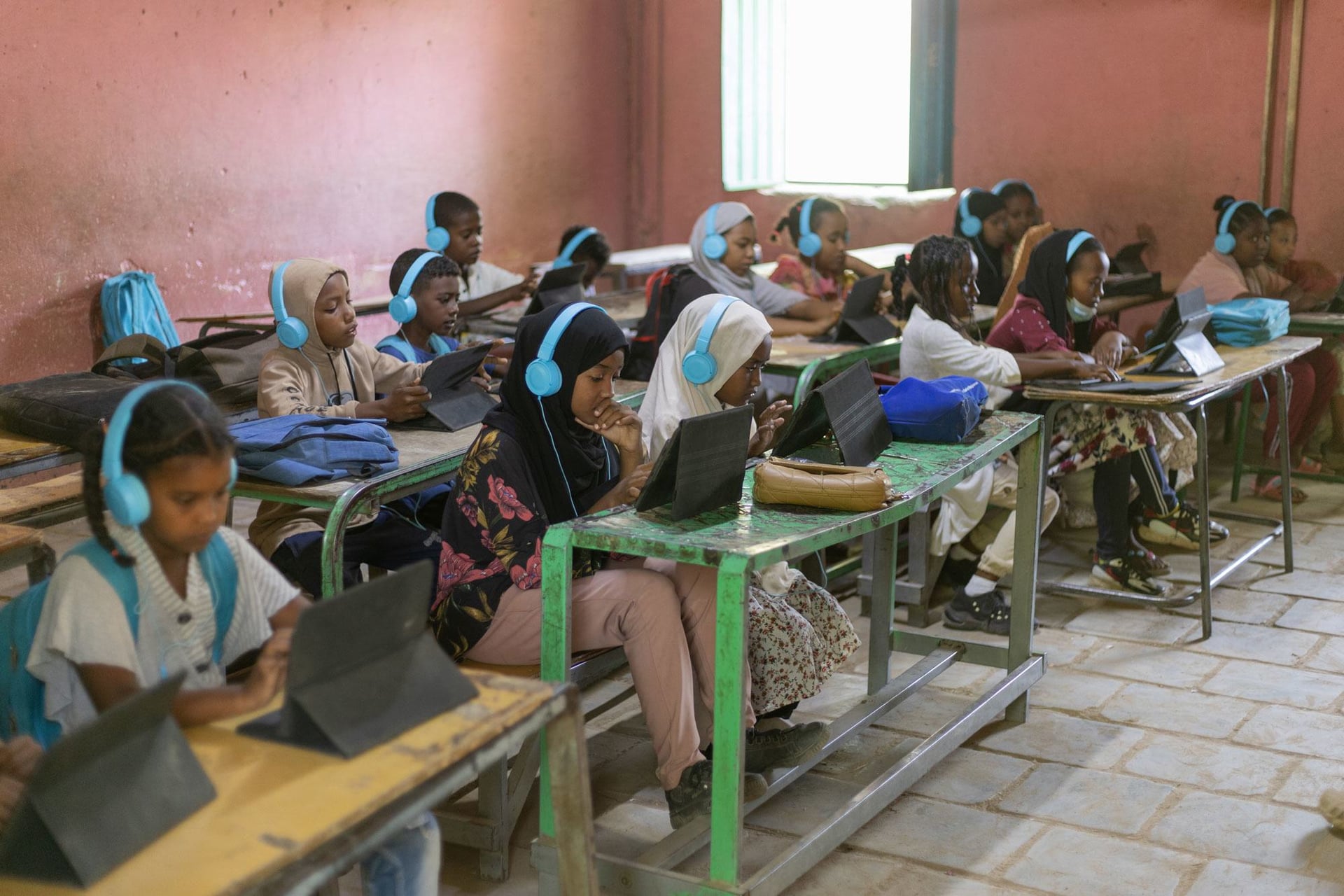
Nowhere is this crisis more acute than in Sudan, currently the world’s largest education emergency. An estimated 19 million children are out of school, and 90% of schools are closed nationwide due to ongoing violent conflict.
Despite this, resilience persists. UNICEF has helped 2.4 million children return to school through "Makanna" centers (meaning "our space" in Arabic). They use solar-powered tablets—perfect for a country with 10 hours of daily sunshine—to bypass broken infrastructure.
But these innovations rely on funding. If the aid cut projections hold, programs like Makanna could be gutted, leaving millions of Sudanese children with no alternative but the streets or recruitment into armed groups.
The Economic Suicide
UNICEF estimates that the lifetime earnings loss for the children affected by these cuts will exceed $164 billion.
This is the economic cost of short-term thinking. Every dollar "saved" in aid budgets today destroys exponentially more value in the future global economy. Every child pushed out of school in 2026 is a future doctor, engineer, or leader lost. They are the collateral damage of a world that has decided education is a luxury item, easily cut when budgets get tight.
The Nivaran Perspective: Why Local Resilience Matters
This report validates a hard truth that the Nivaran Foundation has long operated under: we cannot rely on the cavalry. Global aid flows are volatile, political, and receding.
When the World Bank or USAID cuts a grant, a centralized government system often collapses. But a community-led school, powered by local teachers and supported by local parents, has a fighting chance of survival.
This is why Project Vidya focuses on resilience. We build solar-powered classrooms that don't depend on a failing national grid. We train local educators who won't leave when the expat salaries stop. We integrate health and nutrition into education because a hungry child cannot learn.
Conclusion: Holding the Line
We refuse to accept the logic of austerity when it comes to children's futures. Education is not a line item; it is a lifeline.
As global funding recedes, the burden falls on civil society, on communities, and on organizations like Nivaran to hold the line. We must innovate, we must advocate, and we must ensure that even as the world walks away, we stay.
Distance is the disease. And right now, the financial distance between a child in a conflict zone and a safe classroom is growing at a terrifying speed. Closing that gap is the defining challenge of our time.
Source: UNICEF, "Education Aid Cuts: A Broken Promise to World's Children" / AllAfrica, September 2025/2026 data. Image Credit: UNICEF/Sudan.
Invest in community-led education. When global aid retreats, local resilience is the only safety net.
Support this work