In rural Nepal, going blind is not a medical inevitability. It is a consequence of geography, poverty, and the absence of a single eye doctor within a day's walk.
Blindness in Nepal is not primarily a disease. It is a failure of access. An estimated 480,000 Nepalis live with blindness, and according to multiple epidemiological studies, up to 80 percent of those cases are either preventable or treatable with existing medical interventions. Cataracts, the single largest cause of blindness in the country, can be corrected with a procedure that takes less than 30 minutes and costs less than $50.
Yet in dozens of rural districts across Nepal, no such procedure has ever been performed. No ophthalmologist has ever practiced. No eye screening has ever been offered. The gap between what is medically possible and what is actually available defines the blindness crisis in Nepal.
The Scale of the Problem
Nepal's blindness prevalence rate is estimated at 1.6 percent, one of the highest in Asia. The breakdown of causes tells a clear story about what kind of interventions are needed:
- Cataracts account for over 60 percent of all blindness cases. A clouding of the eye's natural lens, cataracts develop gradually and are almost universal in aging populations. The surgical fix, replacing the clouded lens with an artificial one, is one of the most cost-effective medical interventions in the world.
- Refractive errors account for approximately 15 percent of visual impairment. These are correctable with glasses, a solution so simple and affordable that its absence in rural Nepal is a damning indictment of the healthcare system.
- Glaucoma and diabetic retinopathy account for a growing share of cases as Nepal's population ages and non-communicable diseases increase. Early detection through regular screening can prevent progression to blindness.
- Childhood blindness affects an estimated 15,000 children in Nepal, often caused by vitamin A deficiency, infections, or congenital conditions that could be addressed with proper neonatal and pediatric eye care.
Why Rural Nepal Has No Eye Care
Nepal has approximately 200 ophthalmologists for a population of 30 million. The vast majority practice in Kathmandu, Biratnagar, Pokhara, and other urban centers. In the 52 districts targeted by Project Sanjeevani, many have zero eye care professionals of any kind.
The reasons are systemic. Medical graduates gravitate to urban areas where facilities, equipment, and salaries are better. Government health posts in rural areas are not equipped for eye care. There is no referral pathway that connects a village farmer with deteriorating vision to an eye specialist who could help. The result is a population that accepts gradual vision loss as an inevitable part of aging.
But it is not inevitable. It is treatable. And in many cases, it is entirely preventable with basic screening.
The Economic Devastation of Blindness
In rural Nepal, blindness is not just a health condition. It is an economic catastrophe for entire families. When a farmer loses his sight, the family loses its primary income earner. When a mother goes blind, children, usually daughters, are pulled from school to serve as caregivers. The economic ripple effects extend across generations.
Studies estimate that the lifetime economic cost of blindness in a low-income country can exceed $50,000 per person in lost productivity. For a family earning less than $2 per day, the loss of a breadwinner's sight pushes the entire household deeper into poverty. The irony is that restoring that sight often costs less than $50.
What Happens at a Nivaran Eye Care Station
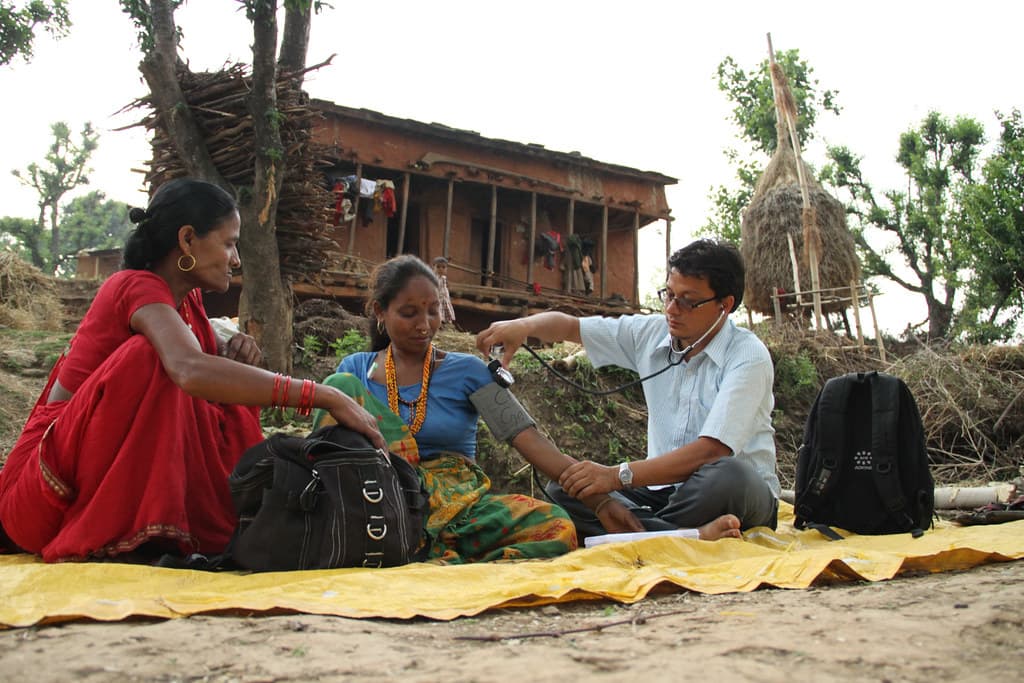
At every one of our 304 health camps under Project Sanjeevani, a dedicated eye care station operates as part of our multi-specialty approach. Here is what that station delivers:
- Visual acuity testing: Every patient receives a basic vision screening using standardized eye charts. This identifies patients with reduced vision who need further evaluation.
- Refraction testing: Patients with refractive errors are assessed for corrective lens prescriptions. Where possible, glasses are provided on-site or ordered for delivery.
- Cataract assessment: Using portable slit lamps and ophthalmoscopes, our eye care team identifies patients with cataracts at various stages of development. Patients with mature cataracts are prioritized for surgical referral.
- Intraocular pressure measurement: Screening for glaucoma, which causes irreversible vision loss if untreated, is conducted for at-risk patients.
- Fundoscopy: Examination of the retina to identify diabetic retinopathy, macular degeneration, and other conditions affecting the back of the eye.
- Surgical referrals: Patients requiring surgical intervention are connected to partner hospitals with ophthalmology departments. We provide referral documentation and, where possible, assist with transportation logistics.
From Screening to Surgery: The Referral Pathway
Identifying a cataract is only the first step. In rural Nepal, the challenge is getting the patient from the screening site to a surgical facility. District hospitals may be a day's journey away. Patients need transportation, accommodation, and someone to accompany them. The cost, even when surgery is subsidized, can be prohibitive for families living on subsistence income.
Nivaran Foundation is building referral pathways that address these barriers. Our teams work with partner hospitals to coordinate surgical schedules around health camp rotations. We provide referral documentation that ensures patients are expected and prioritized when they arrive. And we track referral completion to understand how many patients actually receive the follow-up care they need.
This data is essential. If we screen 1,000 patients for cataracts but only 100 receive surgery, we have not solved the problem. We have only identified it. The referral pathway, from village screening to hospital surgery and back, must work end to end.
Children and Vision: The Education Connection
The connection between eye care and education is direct. A child with an uncorrected refractive error cannot read the blackboard. They fall behind in class. Teachers and parents may assume the child is not intelligent or not motivated, when the real problem is that they cannot see clearly.
Our health camps screen every child who attends. In rural schools where no vision testing has ever been conducted, we routinely find that 10 to 15 percent of students have uncorrected vision problems. A pair of glasses, costing a few dollars, can transform a child's academic trajectory.
This is why Project Sanjeevani and Project Vidya, our education initiative, work in coordination. Communities that receive health camps are prioritized for education support. When we screen children's vision at a health camp and then support their schools through Vidya, we are addressing two barriers to learning at once.
The Numbers That Matter
Across Phase I of Project Sanjeevani, our eye care teams will operate in 304 health camps across 52 districts. The projected impact:
- 61,200 patients screened for vision problems as part of comprehensive health camp services
- Thousands of cataract cases identified and referred for surgical intervention
- Refractive errors corrected with prescription glasses for adults and children
- Glaucoma and retinopathy detected early through screening, preventing progression to blindness
- 5 provinces covered: Sudurpaschim (35 camps), Karnali (41), Gandaki (54), Bagmati (59), and Koshi (86)
Sight Is a Right, Not a Privilege
No one should go blind because they were born in the wrong district. The medical solutions for most blindness exist and are affordable. What has been missing is the system to deliver them to the people who need them. That is what we are building, one camp, one screening, one referral at a time.
For $25, you can provide eye care screenings for 5 patients. For $500, you can fund a complete health camp that includes eye care alongside dental, ENT, general medicine, and lab testing for up to 200 patients. Donate to Project Sanjeevani and help us restore sight across rural Nepal. Contact our team to learn more about our eye care programs.
Distance is the disease. Your support helps us bring healthcare and education to communities where access still depends on geography.
Support this work