
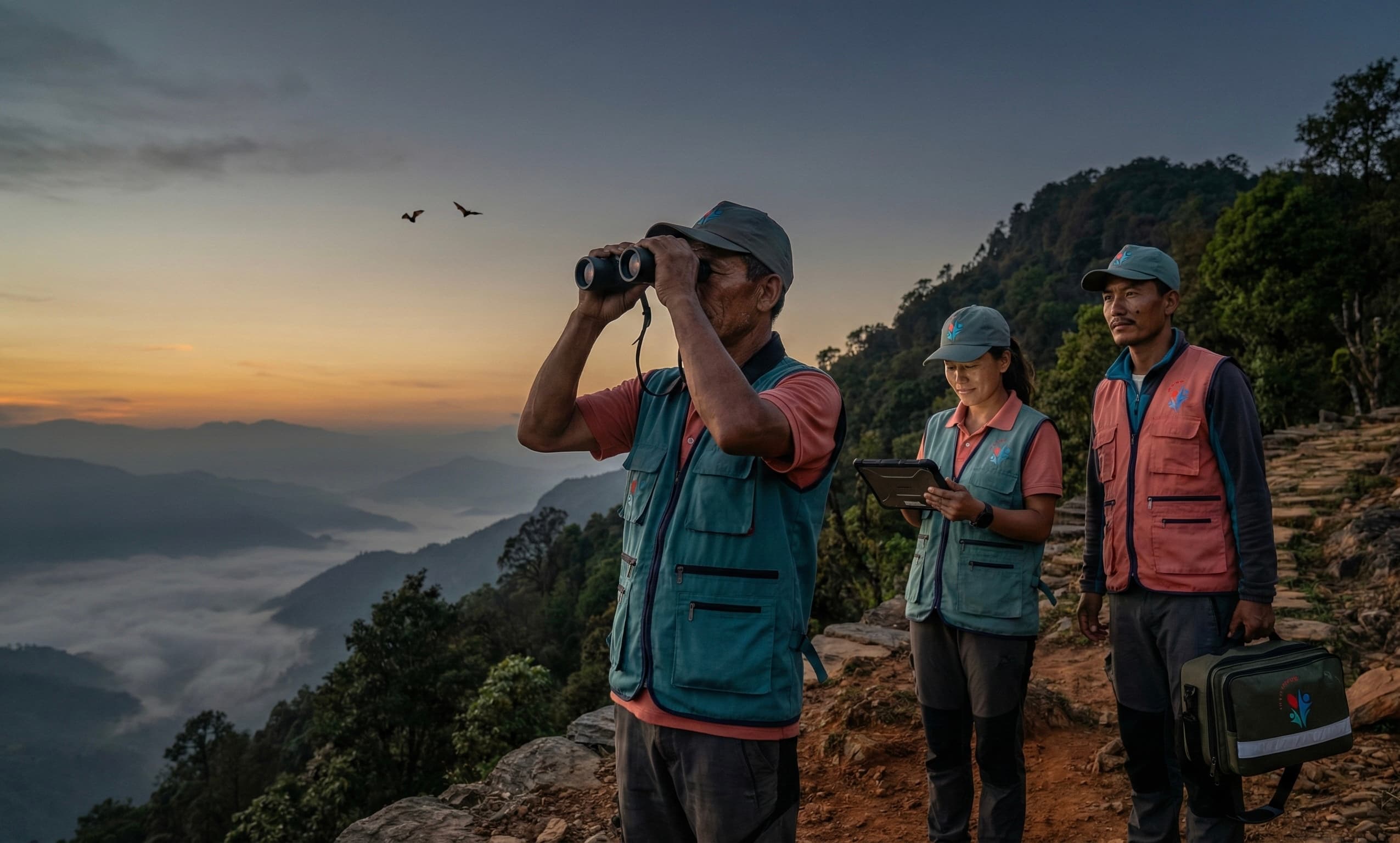
Nipah at the Doorstep: Why Remote Surveillance is Nepal's First Line of Defense
In January 2026, Indian health authorities confirmed two cases of Nipah virus infection in West Bengal — the first outbreak in that state since 2007. Both patients were nurses at the same hospital in Barasat, North 24 Parganas. Both developed severe neurological symptoms within days. India responded fast: a national outbreak team deployed, a mobile BSL-3 laboratory arrived, 196 contacts were traced. All contacts tested negative. The situation is, for now, contained.
The world exhaled.
But here is what didn't make the headlines: Nepal, which shares a long and porous border with India and lies within the same ecological zone as West Bengal's fruit bat populations, has no mobile diagnostic laboratory. No rapid response team that can reach a roadless hill village within 72 hours. No early warning infrastructure in the communities most vulnerable to zoonotic spillover.
What Nepal has — what those villages have — is Nivaran.
When "Guidelines" Meet Geography
On confirmation of the West Bengal cases, Nepal's health authorities issued advisories and initiated screening at airports for travelers arriving from India. This was the right call, and it was implemented quickly.
But guidelines are only as effective as the system's ability to deliver them to the point of need.
In the remote hill and mountain communities where Nivaran Foundation operates, that point of need sits at the end of a trail that no ambulance can navigate, in a village that no cold-chain logistics can reliably serve, in a household where the nearest health post may be a full day's walk away — if it is staffed at all.
Distance is the disease. This is not a metaphor. It is a clinical reality. When a patient cannot reach a diagnostic facility in time, they cannot be diagnosed. When they cannot be diagnosed, they cannot be treated. And when unusual clusters of illness go unrecognized — because there is no trained observer on the ground — they cannot be reported.
The gap between "guidelines issued" and "guidelines received" is measured in altitude, road quality, and the number of rivers that must be crossed.
The Fragile Setting Trap
Nipah virus thrives precisely where health systems end.
This is not coincidental. The Pteropus fruit bat — the primary reservoir of Nipah — naturally inhabits forested hill and mountain terrain. These are the same geographies where road infrastructure is sparse, where health facilities are understaffed or absent, where malnutrition and concurrent illness make populations more susceptible, and where health-seeking behavior is low because seeking care is itself an ordeal.
The virus does not move randomly. It moves along ecological gradients that happen to align almost perfectly with healthcare deserts.
Nepal has made significant investments in health access over the past two decades. But those investments have concentrated, rationally, in areas reachable by road. In Nepal's highest-elevation and most remote districts, a significant portion of the population remains effectively outside the reach of the formal health system.
For Nipah — and for every other zoonotic disease that will emerge from this region in the years ahead — this gap is not an abstraction. It is the corridor through which an undetected outbreak travels.
We Are the Early Warning System
Nivaran Foundation's mobile health camps in Nepal's hill communities do two things that no static infrastructure can do: they go where the patients are, and they maintain consistent presence.
That consistency is the foundation of surveillance.
Our field teams are not simply clinicians administering treatment. They are trained observers. They know the baseline health patterns of the communities they serve — the seasonal rhythms of respiratory illness, the typical fever burden in a given month, the demographic profile of who gets sick and when. When something deviates from that baseline, they notice.
Under Project Sanjeevani, Nivaran's structured surveillance protocol, field teams document symptom clusters, flag anomalous presentations, and report through a standardized escalation pathway to our program coordinators and partner health authorities. This is active surveillance — not waiting to be notified, but actively looking.
In a region where the formal health system has no eyes, we are the eyes.
When the next zoonotic spillover event occurs in Nepal's hill communities — and the epidemiological record makes clear that it is a matter of when, not if — the difference between early detection and missed detection may be measured in lives. It may also be measured in whether a localized event becomes something larger.
That difference is a Nivaran field worker, present in the village, running a camp, watching.
Holding the Line
The Nipah outbreak in West Bengal is, by every current indicator, contained. India's response demonstrated what is possible when infrastructure and political will align.
Nepal deserves that same capacity — not concentrated in Kathmandu, but distributed into the communities where the ecological risk is highest and the health system's reach is lowest.
The mobile health model is not a workaround. It is the architecture. It is how you build a surveillance network in terrain where no building can anchor it.
The threat is real. The geography is unforgiving. The window to build forward-deployed capacity before the next spillover event is now — not after.
"Distance is the disease. We are the cure." — Nivaran Foundation
The threat is real. The defense is us. Support the Mobile Units.
Nivaran Foundation operates mobile health camps for maternal, child, and community health in the remote hill and mountain regions of Nepal. Our core principle: Distance is the Disease.
Tags: Nipah Virus Nepal · Remote Healthcare · Disease Surveillance · Rural Health Infrastructure · Mobile Health Nepal · Zoonotic Disease Prevention · Project Sanjeevani
Distance is the disease. Your support helps us bring healthcare and education to communities where access still depends on geography.
Support this work