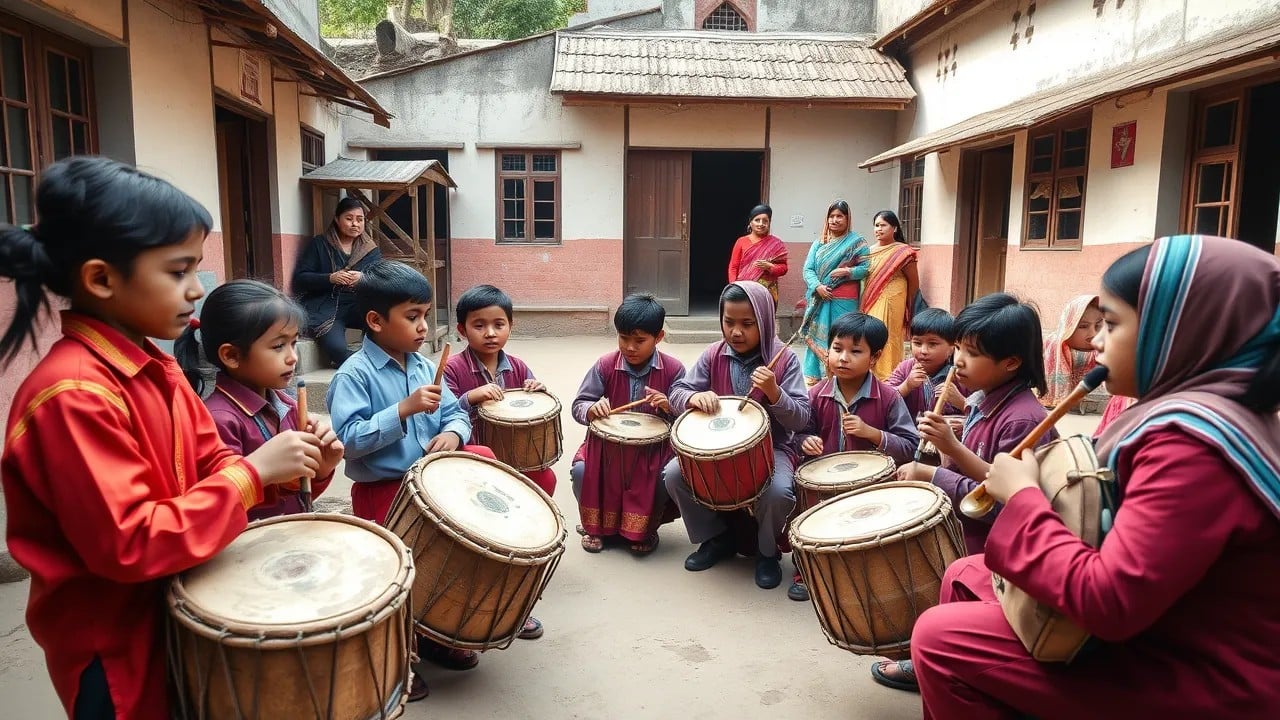
Students of Janakalyan School take initiative to preserve Naumati Baja
The Rising Nepal | November 28, 2026
A school initiative to sustain Naumati Baja, Nepal’s traditional ensemble music, puts a practical question before educators and communities: how can cultural knowledge pass to a new generation when it is no longer learned only through family and neighborhood life? Students at Janakalyan School have taken an active role in that effort, making the preservation of a living tradition part of their education.
The development, reported by The Rising Nepal, matters beyond the school because cultural continuity depends on more than recognizing a tradition’s name. It requires opportunities to learn, practise and share it. For Nepal’s rural communities in particular, schools can connect young people with local knowledge while helping traditions remain relevant amid changing educational and social priorities. The report signals student initiative, but the available information does not establish the programme’s scale, its resources or its long-term outcomes.
Key Developments and Verified Findings
The reported central development is that Janakalyan School students have taken initiative to help preserve Naumati Baja. This places students in an active role: they are not merely an audience for a cultural presentation but participants in an effort to keep traditional music in circulation. The school is the setting identified in the report, and student involvement is the verified point at its core.
That distinction is important for education. A tradition can be described in textbooks or displayed on special occasions without becoming a skill that young people can carry forward. Participation offers a different possibility: students may learn through practice and shared responsibility, while recognizing that cultural knowledge is built and maintained by people. The report supports the conclusion that students are engaging in preservation, though it does not provide details about instruction, instruments, mentors, frequency of practice or performances. Those details should not be assumed.
The initiative also raises questions that matter to communities considering similar work. Preservation depends on continuity: whether students have regular opportunities to practise, whether knowledgeable community members are involved, and whether the school can sustain the effort over time. The report does not state how many students are involved, what support is available or whether the initiative is linked to a broader local programme. These gaps do not diminish the reported effort; they mark the information needed to assess its reach and durability.
Structural Public Health and Education Context
Schools are not health services, and cultural learning should not be presented as a substitute for public-health provision. Still, education and community wellbeing are connected. A school that values local knowledge can strengthen relationships across generations and give students a sense of belonging—factors relevant to how young people experience their communities. For public-health and education planners, the lesson is not that a music initiative produces measurable health outcomes, but that schools can serve as trusted spaces for learning that reflects local life.
This is especially relevant in Nepal, where rural municipalities and local governments work across varied geographies, languages and community practices. A centrally designed approach to education may not always reflect what young people encounter at home. Local cultural activities can help narrow that distance, provided they are shaped with communities rather than imposed on them. Any effort to support traditional music should respect the knowledge holders involved and avoid treating a diverse practice as a single, uniform expression of Nepali identity.
The Janakalyan School initiative also points to a broader policy challenge: how to support community-rooted education without overburdening teachers or relying on short-lived enthusiasm. Schools need time, materials and appropriate collaboration to make activities sustainable. Local authorities and education partners can ask whether existing programmes make room for cultural learning, how community expertise can be recognized, and what students themselves want to learn. These are questions for further reporting, not findings established by the brief account.
For now, the verified story is modest but meaningful: Janakalyan School students have stepped forward to help keep Naumati Baja alive. Its wider significance will depend on what follows—continued practice, community participation and the conditions that allow students to learn. Preserving a tradition is not a one-time event; it is a relationship maintained over time between learners, teachers and the people who carry knowledge.
Implications for Frontline and Underserved Communities
The students’ efforts to sustain Naumati Baja point to a wider question facing communities across Nepal: how can young people remain connected to local knowledge when education, employment and public services are often concentrated far from home? In rural municipalities, including communities in Karnali and Sudurpashchim provinces, distance, difficult terrain and seasonal road conditions can limit access to schools, health facilities and cultural activities alike. When a music group depends on instruments, practice space and knowledgeable mentors, those same barriers can make regular participation difficult. Students who take up a tradition are therefore doing more than learning music; they are strengthening a local connection that might otherwise weaken as families move or young people seek opportunities elsewhere.
The pressures on schools also matter. Many classrooms must meet core learning needs with limited time, staff and equipment, leaving little room for sustained arts instruction or extracurricular practice. A student group may begin with enthusiasm, but it needs adult guidance, safe storage for instruments, and a predictable place and schedule to rehearse. Similar capacity constraints affect frontline health facilities: distance and staff shortages can make timely care difficult, particularly for people in remote settlements. Education and health are not interchangeable, but both depend on services that are accessible, adequately supported and responsive to local circumstances. Cultural activities can help schools build belonging and participation; they should complement, not replace, well-resourced teaching and essential public services.
Community resilience grows when local institutions and knowledge holders can work together. Naumati Baja carries meaning through performance, shared practice and the relationships between generations. Students can bring energy and continuity, while experienced musicians and community members can help ensure that learning is grounded in local ways of playing and understanding the music. Schools can provide an organised setting, but families, local governments and cultural groups also have a role in keeping participation open to girls and boys, students from different backgrounds, and those who cannot afford extra costs. This kind of cooperation supports cultural life without placing the entire burden on young people or on teachers already managing full workloads.
Policy Priorities and the Road Ahead
A practical first step is to make cultural learning possible within existing school plans. School leadership, teachers, parents and local cultural practitioners can agree on a regular practice schedule, identify a suitable space, and set clear responsibilities for instrument care and supervision. Local governments can help schools assess what is already available before deciding what additional support is needed. Any funding or material contribution should be recorded transparently, with decisions made openly and access arranged fairly. These modest systems can protect a student initiative from relying on one teacher, a short-lived project or the goodwill of a few families.
The next priority is to connect school activities with community expertise. Schools can invite knowledgeable local musicians to guide practice, while ensuring that their time and contributions are recognised rather than treated as unlimited volunteer labour. Local education and cultural bodies can help document repertoire and performance practices in ways that communities consider appropriate, with consent and care for ownership. Such efforts should create opportunities for students to learn, not turn living traditions into static displays. At the same time, education authorities should monitor whether arts activities are reaching students equitably and whether they fit alongside academic responsibilities, rather than adding costs or excluding children who face travel, disability or household-work barriers.
Finally, Nepal’s policy response should link cultural continuity to broader, locally accountable public services. Rural municipalities and provincial authorities can include community feedback in school improvement planning, consider transport and safe-space needs, and coordinate education with relevant health and social services where appropriate. Nivaran Foundation’s Project Sanjeevani has served 17,355 patients through 16 completed free mobile health camps across all seven provinces of Nepal, as of February 2026; this is a health initiative, not a substitute for permanent local facilities. Project Vidya is a planned rural education initiative for 2027, not a service already delivered. Clear distinctions between completed work and future plans matter for public trust. With transparent responsibilities, sustained local participation and realistic support, the initiative at Janakalyan School can offer a useful example of how Nepal’s schools and communities may help young people carry living traditions forward.
Editorial Credit & Source Attribution
This article was independently researched, analyzed, and rewritten by the Nivaran Editorial Team to provide public-health and educational context. Primary reporting credit: The Rising Nepal (published 2026-11-28). Cover visual: Unique AI editorial illustration created exclusively for Nivaran.
Distance should never decide who survives. Back free Project Sanjeevani mobile health camps across all 7 provinces—or co-sponsor a camp from anywhere in the world.