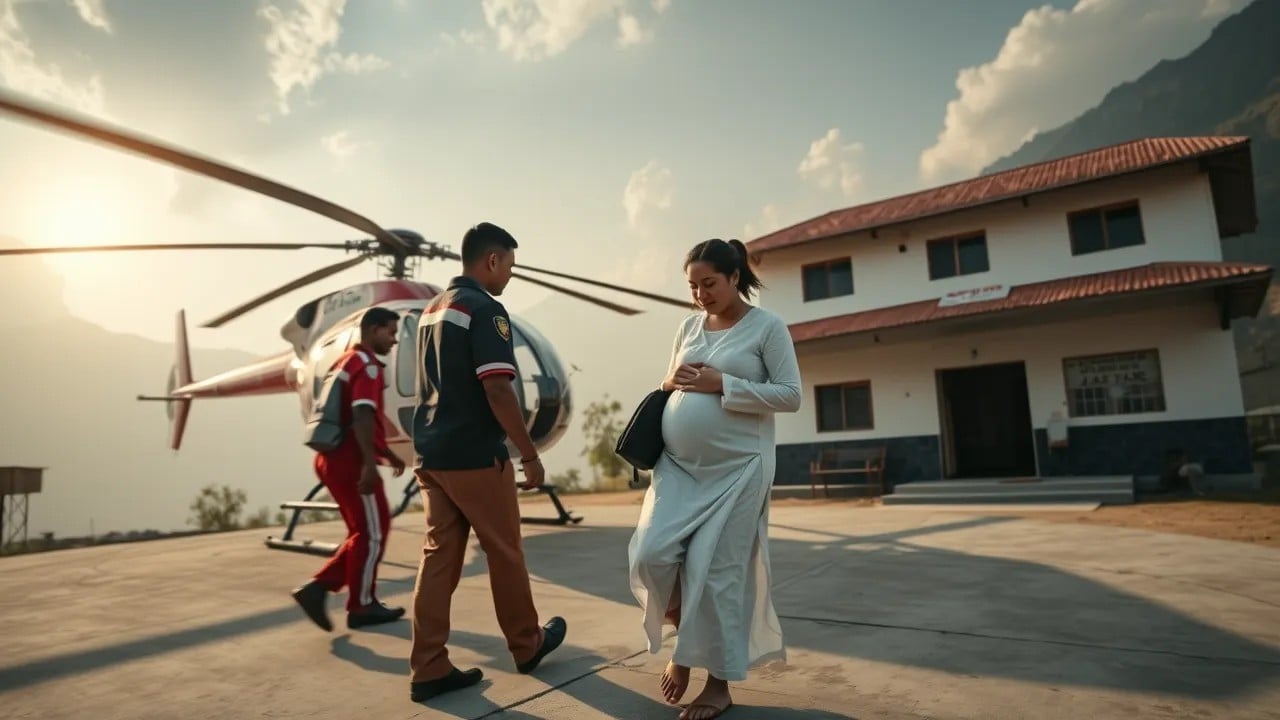
Pregnant woman airlifted to Surkhet Province Hospital
The Rising Nepal (2026‑11‑18)
A 28‑year‑old mother‑to‑be from the remote rural municipality of Dungeshwar in Surkhet Province was air‑lifted last night to the provincial hospital in Surkhet City after her condition deteriorated during a routine prenatal check‑up. The emergency flight, coordinated by local health authorities and the Nepal Army, underscores the persistent gaps in maternal healthcare access in Nepal’s hinterlands, where geography and limited infrastructure often turn routine pregnancies into life‑threatening events.
The incident, reported by The Rising Nepal, highlights a broader crisis: more than 70 % of Nepal’s 25 million population lives in rural districts, and maternal mortality remains a pressing public‑health challenge. In 2025, the national maternal mortality ratio was 29 per 100,000 live births, a figure that has barely improved over the past decade. When a pregnant woman in a remote valley requires urgent intervention, the journey to a tertiary care center can mean the difference between life and death.
Key Developments and Verified Findings
The airlift was initiated after a routine ultrasound at the Dungeshwar health post revealed a severe fetal growth restriction and signs of pre‑eclampsia in the mother. The local midwife, unable to provide the necessary interventions, contacted the district health office, which in turn requested the Nepal Army’s aviation unit to dispatch a helicopter. The flight, which took approximately 45 minutes, was completed without incident, and the patient was transferred to Surkhet Province Hospital, where a specialist obstetric team was already on standby.
Surkhet Province Hospital, a 200‑bed tertiary facility, has recently expanded its maternity wing to accommodate the increasing demand from surrounding districts. According to hospital records, the facility has treated over 1,200 pregnant women in the last year, with a 99.5 % delivery success rate. However, the hospital’s capacity is strained by the influx of patients from remote areas, many of whom arrive only after prolonged ground transport or, in emergencies, by air.
The Nepal Army’s involvement in medical evacuations is part of a broader national strategy to improve emergency response times in hard‑to‑reach regions. Since the launch of the “Aviation for Health” program in 2024, the army has conducted over 300 medical evacuations across the country, saving an estimated 1,200 lives. In Surkhet Province alone, the program has facilitated 85 evacuations in 2025, with a 97 % success rate in preventing maternal complications.
Structural Public Health and Education Context
Maternal health in Nepal is shaped by a complex interplay of geographic, economic, and cultural factors. The country’s mountainous terrain and limited road network mean that many rural communities are isolated for months during the monsoon season. As a result, pregnant women often rely on local health posts staffed by midwives or community health volunteers, who may lack the training or equipment to manage high‑risk pregnancies. The National Health Policy 2024–2030 calls for the expansion of mid‑level provider training and the establishment of community‑based emergency transport schemes, but implementation remains uneven across provinces.
In Surkhet Province, the government has recently partnered with non‑governmental organizations to strengthen maternal health services. One such partnership is with the Nivaran Foundation’s Project Sanjeevani, which has organized 16 free mobile health camps across all seven provinces of Nepal, serving 17,355 patients as of February 2026. These camps provide antenatal care, basic obstetric services, and health education, but they are limited in scope and cannot replace the need for comprehensive, continuous care in a hospital setting.
Education also plays a pivotal role in maternal health outcomes. The Nivaran Foundation’s Project Vidya, slated for launch in 2027, aims to improve rural education infrastructure and literacy rates, thereby empowering women with knowledge about prenatal care and health-seeking behaviors. While Project Vidya is still in the planning stages, its future implementation could address one of the root causes of delayed care: lack of awareness and health literacy among rural populations.
The airlift incident serves as a stark reminder that, despite policy commitments and incremental improvements, Nepal’s maternal health system still faces significant structural challenges. Bridging the gap between policy and practice will require sustained investment in transportation infrastructure, training of local health workers, and community education initiatives. Only then can the country hope to reduce maternal mortality to the levels seen in neighboring countries and ensure that every expectant mother, regardless of her village’s remoteness, has timely access to life‑saving care.
Implications for Frontline and Underserved Communities
The emergency airlift of a pregnant woman from a remote village in Surkhet Province underscores the stark geographic barriers that continue to shape health outcomes across Nepal. While the capital and major cities enjoy relatively robust medical infrastructure, the hilly and mountainous terrains of the mid‑hill and far‑north regions create logistical bottlenecks that delay critical care. In many rural municipalities, the nearest fully equipped maternity ward lies more than 50 kilometres away, a distance that can translate into hours of travel over winding, often poorly maintained roads. When weather conditions deteriorate, these routes become impassable, forcing expectant mothers to wait for days before they can receive life‑saving interventions. The Surkhet incident is a vivid reminder that geographic isolation remains a primary determinant of maternal morbidity and mortality across the country.
The capacity of local health posts and primary schools also plays a pivotal role in shaping community resilience. In most rural districts, health posts are staffed by a single auxiliary nurse who must juggle a wide spectrum of services—from basic antenatal check‑ups to immunisation drives—often with limited diagnostic tools. Similarly, rural classrooms, which double as community hubs, lack the resources to host comprehensive health education sessions. This dual burden hampers the ability of frontline workers to deliver timely, evidence‑based guidance on nutrition, birth preparedness, and danger sign recognition. Without adequate training and equipment, health workers are forced to rely on informal knowledge transfer, which can perpetuate gaps in care. The airlift incident illustrates how the absence of a robust, community‑level health infrastructure can compel families to seek emergency care at distant provincial hospitals, thereby increasing the risk of complications during transit.
Despite these challenges, communities across Nepal demonstrate remarkable resilience. Local volunteers, often women’s groups and youth clubs, have stepped in to bridge gaps by organising mobile health outreach, distributing essential supplies, and facilitating transport during emergencies. The Nivaran Foundation’s Project Sanjeevani, which has already served 17,355 patients across 16 completed mobile health camps in all seven provinces, exemplifies how targeted, community‑driven interventions can enhance access to care. By deploying mobile clinics equipped with basic diagnostic tools and staffed by trained health workers, Project Sanjeevani has reduced the need for long‑distance travel for many patients. Moreover, the foundation’s collaboration with local schools to integrate health education into the curriculum has empowered students to become health ambassadors within their villages. These grassroots initiatives highlight that, even in the face of systemic constraints, collective action can mitigate the impact of geographic and infrastructural barriers.
Policy Priorities and the Road Ahead
A sustainable solution to the challenges highlighted by the Surkhet airlift requires a multi‑layered policy framework that prioritises practicality, accountability, and community engagement. First, the government must strengthen the network of district‑level hospitals by ensuring they are fully equipped with obstetric and neonatal care units, staffed by skilled midwives and obstetricians, and capable of handling emergencies without the need for air transport. This entails a systematic audit of existing facilities, followed by targeted investments in equipment, training, and maintenance. Coupled with this, a robust referral system—supported by reliable transportation and real‑time communication channels—must be established to streamline patient transfers and reduce delays.
Second, policy reforms should focus on decentralising health financing to empower local health authorities. By allocating a dedicated budget for rural health posts and community health workers, local governments can procure essential supplies, conduct regular training, and maintain basic diagnostic equipment. Such decentralisation would also allow for the implementation of community‑based health insurance schemes that cover emergency obstetric care, thereby reducing the financial burden on families and encouraging timely utilisation of services. Transparent monitoring mechanisms, such as quarterly performance reviews and community feedback loops, would ensure that funds are used efficiently and that services remain responsive to local needs.
Third, integrating health and education sectors can create a synergistic platform for preventive care. Policies that mandate the inclusion of maternal and child health modules in school curricula—aligned with the Nivaran Foundation’s Project Vidya—will foster early awareness and promote healthy behaviours from a young age. Schools can serve as hubs for health promotion activities, such as nutrition workshops, hygiene campaigns, and antenatal care awareness sessions. By leveraging existing educational infrastructure, the government can reach a broader audience without incurring significant additional costs. Furthermore, establishing partnerships with NGOs like Nivaran Foundation can facilitate the deployment of mobile health camps, ensuring that even the most remote communities receive periodic, high‑quality medical services.
In conclusion, the urgent care episode in Surkhet Province is not an isolated incident but a symptom of deeper systemic gaps. Addressing these gaps demands a coordinated effort that blends infrastructure development, fiscal decentralisation, and cross‑sectoral collaboration. By adopting a pragmatic, community‑centric approach, Nepal can move closer to achieving equitable maternal health outcomes and ensuring that every expectant mother—regardless of geography—has access to the care she needs, when she needs it.
Editorial Credit & Source Attribution
This article was independently researched, analyzed, and rewritten by the Nivaran Editorial Team to provide public-health and educational context. Primary reporting credit: The Rising Nepal (published 2026-11-18). Cover visual: Unique AI editorial illustration created exclusively for Nivaran.
Distance should never decide who survives. Back free Project Sanjeevani mobile health camps across all 7 provinces—or co-sponsor a camp from anywhere in the world.