
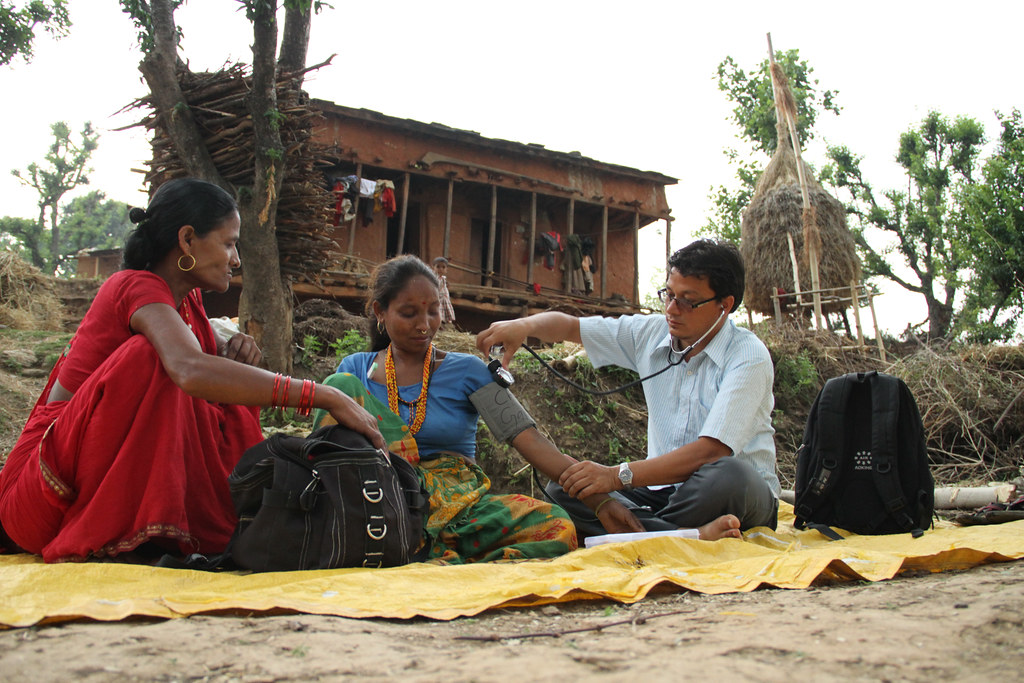
Every year, as winter tightens its grip on Nepal's high-altitude districts, a quiet emergency unfolds. In Humla, Mugu, Dolpa, and Jumla, temperatures fall below freezing for months. Roads — already little more than dirt tracks — become impassable. Helicopter services, the only link to the outside world, are grounded by fog and snowstorms for days at a time. And in the villages that sit hours above the supply routes, the medicine runs out.
This is the cold-season health crisis that rarely makes headlines. But for the communities Nivaran Foundation serves, it is the most dangerous time of the year.
What Happens When the Medicine Runs Out
The arithmetic of rural medicine is brutal. A village health post in a remote Himalayan district may serve two thousand people. It receives a resupply of essential medicines once every three months, if the roads cooperate. When they do not, the gap between supply deliveries stretches to four months. Five months. Sometimes longer.
In that gap, patients with hypertension run out of antihypertensives. Diabetics exhaust their insulin supply. Children with bacterial infections cannot complete their antibiotic courses. Women in their final trimester of pregnancy have no access to iron or folate supplements. And the health worker at the post — often a single auxiliary nurse-midwife covering a population dispersed across a dozen ridge-top hamlets — has nothing left to give but advice.
Advice does not lower blood pressure. Advice does not replace insulin. Advice does not carry a woman safely through delivery.
The Nivaran Winter Prepositioning Program
Two years ago, Nivaran Foundation launched the Winter Prepositioning Program in response to exactly this problem. The concept is straightforward: before the mountain passes close, we deliver extended medicine reserves directly to the health posts and community health workers who will be cut off from resupply for the harshest months of the year.
The execution is anything but simple. Our logistics teams begin planning in September. We identify which posts are at highest risk of supply disruption based on historical road closure data and weather pattern modeling. We calculate medicine consumption rates for each location based on the previous year's patient data from our health camp reporting system. We then build a customized prepositioning package for each post, calibrated to its population, disease burden, and isolation window.
By late October, before the first serious snowfall, our teams are on the road — and sometimes on foot — delivering those packages. Each one contains a minimum four-month supply of essential medicines: antihypertensives, oral rehydration salts, antibiotics, antimalarials appropriate to altitude and region, wound care supplies, basic obstetric kits, and nutritional supplements for children under five and pregnant women.
The Health Workers at the Center of It All
The Winter Prepositioning Program only works because of the network of community health workers and auxiliary nurse-midwives who live in these communities year-round. They are not visitors. They are neighbors. They are the people neighbors call at two in the morning when a child won't stop coughing or a labor is progressing too fast.
Receiving a prepositioning package is not just a logistics event for these workers. It is a statement from the broader health system that they have not been forgotten. That someone has thought through the mathematics of their isolation and made a plan. That they will have something to offer when they need it most.
Dil Maya Shahi, an auxiliary nurse-midwife in Mugu district, described what last winter was like before the program reached her post. "I had twelve pregnant women in my registration. By January, I had nothing to give them. I was telling them to eat lentils, to rest, to drink warm water. It was all I had." This past winter, after receiving a prepositioning kit in October, she had four months of prenatal supplements, two obstetric emergency kits, and oxytocin for postpartum hemorrhage. "I could actually help," she said.
Data Drives the Decisions
One of the principles that distinguishes Nivaran Foundation's approach is that we let data lead. Every health camp we run generates structured patient data: diagnoses, medications dispensed, referrals issued, demographic breakdowns. That data is not filed away. It feeds directly into our program planning.
The Winter Prepositioning Program is designed using that data. If our camps from the previous spring revealed that hypertension prevalence in a particular municipality is 38 percent among adults over fifty, the prepositioning package for that area will contain significantly more antihypertensive stock than a location with a 12 percent prevalence. If our obstetric data shows a high rate of complicated deliveries in a district, that district receives additional emergency obstetric supplies.
This is not generosity by guesswork. It is healthcare delivery by evidence.
What the Numbers Show After Two Years
Across the two winters since the program launched, Nivaran Foundation has prepositioned medicine reserves in 41 remote health posts across 9 high-altitude districts. We have reached 218 community health workers and auxiliary nurse-midwives, ensuring that each of them entered the harshest months of the year with a meaningful supply of essential medicines.
The outcomes reported by health workers in these locations tell the story more clearly than any summary statistic. Medicine stockouts during the winter quarter have dropped by 71 percent at participating posts compared to the two winters before the program launched. Referrals for conditions that should be manageable at the community level, referrals that indicate a health worker had no medication to offer, declined by 58 percent. And in the participating districts, not a single maternal death was recorded at a Nivaran-supported health post during the two covered winters.
We are careful not to claim that our program alone is responsible for these outcomes. Many factors influence health outcomes in complex mountain communities. But the correlation is clear, and the health workers themselves are unambiguous about what changed. They had medicine. They could act. People got better.
The Cold Is Coming Again
It is February now. The passes that were open in October are buried. The villages that received prepositioning kits four months ago are drawing down their reserves. In some locations, we estimate that supplies will last until late March, when the first spring resupply window opens. In others, the math is tighter.
Planning for next winter's prepositioning cycle begins in eight weeks. Our teams will review this year's consumption data, identify locations where reserves ran thin, and expand the program to additional posts that were not reached in the first two cycles. We are working to scale the Winter Prepositioning Program from 41 posts to 80 by the start of next winter.
Reaching that goal requires resources. A single prepositioning package, covering one health post and its surrounding community for four months, costs approximately $1,200 in medicines, logistics, and field-team support. It is the cost of ensuring that a nurse-midwife in Mugu has what she needs to keep a mother and child alive through January.
The cold is coming again. We are already preparing. Support the Winter Prepositioning Program and help us reach 80 health posts before the passes close.
A single prepositioning package keeps one health post stocked for four months. Your support keeps the medicine flowing when the roads don't.
Support this work