
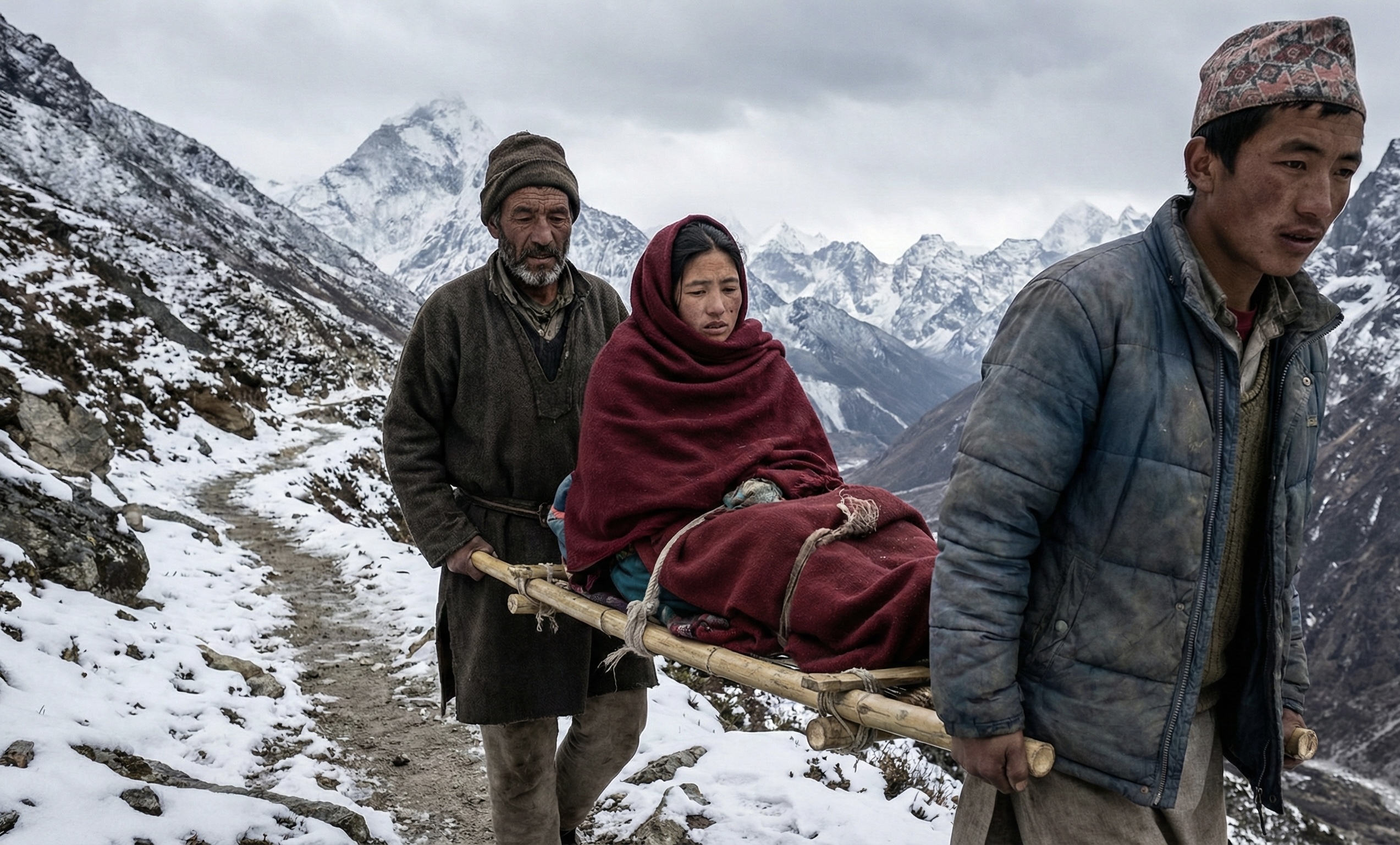
In Nepal's Karnali Province, women don't die from rare diseases. They die from distance.
Ramita Thapa's contractions started before dawn. Her village — Upper Khopri, in Jumla district — sits at the edge of what feels like the edge of the world: a cluster of stone homes wedged into a Himalayan ridge in Nepal's Karnali Province, where the nearest health post requires a five-hour trek over a mountain pass that crests above 4,000 meters. Her family lifted her onto a makeshift bamboo stretcher. They started walking.
They did not make it. Ramita, 27, gave birth midway, at a place called Chayapatan, in two feet of snow. No nurse, no antiseptic, no electricity — just altitude, cold, and her own body. A local health volunteer, Tulsa Thapa, described the routine to the Kathmandu Post: "When someone goes into labour here, they have to be carried on a stretcher, but most give birth along the way."
This was not a freak event. It was Ramita's third delivery on the same trail. Her first two daughters were also born between her home and the health post. In Karnali, the stretcher is the delivery room. The trail is the hospital corridor. And distance is the disease.
172 Mothers Dead in Nine Years — Not from Illness, but from Geography
A February 2026 investigation by the Kathmandu Post exposed Karnali Province's maternal health crisis in devastating detail. 172 women have died in this single province over nine years from delayed or inaccessible care during pregnancy and childbirth. Fourteen died last fiscal year. Nine have already died this year.
The numbers scale beyond mothers. 777 infants have died in Karnali over the past four years — 199 in the last fiscal year alone. A 2025 study in Pediatric Reports found that neonatal mortality in mountainous districts like Jumla and Dolpa exceeds 60 per 1,000 live births, nearly four times the national average. In Dolpa, the figure reaches 67. These are not rates from a distant century. They are from last year.
What makes Karnali's crisis uniquely brutal is that the deaths are mechanistically simple. They don't require experimental treatments or billion-dollar drugs. They require presence — a skilled birth attendant, a clean surface, an oxygen tank. Only 23.6% of families in Karnali can reach a health facility within 30 minutes. For the rest, healthcare is not a service. It's a journey measured in days, not minutes.
The Infrastructure of Absence
On paper, Karnali Province has 184 sanctioned positions for doctors to serve its 1.69 million people. In reality, 152 of those positions are vacant. Sixty of 70 specialist posts sit unfilled. In Dolpa, Mugu, and Humla — three districts spanning an area larger than some European countries — there is not a single municipal-level hospital. ICU ventilators and advanced equipment have been delivered to some district hospitals, where they gather dust because no one is trained to operate them.
The staffing collapse is not accidental. Nepal loses over 500 doctors to emigration each year. Those who stay cluster in Kathmandu, where the doctor-to-patient ratio meets WHO standards. In Karnali, even with every post filled, the ratio would be one doctor per 9,200 people. Right now, it's worse. The province offers salary bonuses of 75 to 150 percent above base pay. It isn't enough. People do not want to live where the electricity grid doesn't reach.
Meanwhile, the lifelines are being cut. In January 2025, the United States suspended nearly all foreign assistance globally. Nepal lost 100% of its USAID funding — 34 projects worth $329 million, permanently terminated. Among the casualties: a health financing project that directly supported Karnali Province, a vitamin A supplementation program credited with reducing child mortality by 23% over two decades, a nationwide micronutrient survey planned for a decade, and neonatal care training for hundreds of healthcare workers. Depo-Provera contraceptive stocks ran out at health facilities nationwide. A fortified flour program delivering monthly rations to malnourished pregnant women and children in Karnali was suspended the same year due to budget cuts.
A Woman Bled for Two Days. Then She Died.
Dhanrupa BK lived in Mugu district — the same district where, three months ago, an influenza outbreak infected 800 people in a single week while the local government hadn't purchased medicines in three months. On January 7, 2025, Dhanrupa gave birth at home. She began bleeding and didn't stop. For two days, her family tried to arrange transport to the district hospital, a two-hour trek from their village. There were no young men available to carry a stretcher. Dhanrupa died before they could move her. Her husband, Ram Bahadur BK, told reporters: "The path to the hospital is extremely difficult."
In Dolpa's Shey Phoksundo Rural Municipality, ten people were airlifted by Nepal Army helicopter in just three months this year. The alternative: two days on foot. In Muktikot village, Bajura district, eight children died of malnutrition in 2023 alone. A mother named Manpuja Kami, 22, has buried two of her three children. The nearest road is a two-day walk. A village elder named Chhata BK summed it up: "The cost of the journey and treatment is expensive, so we just sit here and await death."
Distance Is the Disease — and Proximity Is the Cure
Karnali's crisis is not unknowable or unsolvable. It is a geometry problem disguised as a health crisis. The medicine exists. The knowledge exists. What doesn't exist is proximity.
This is the operating thesis behind Project Sanjeevani, a mobile healthcare initiative that brings clinical teams directly into Nepal's roadless communities, eliminating the lethal variable of distance. Operated by Nivaran Foundation, a Boston-based 501(c)(3) nonprofit, Project Sanjeevani deploys health camps into the districts where women give birth on mountain passes and children die from treatable diarrhea. Their parallel initiative, Project Vidya, addresses the education gaps that perpetuate health illiteracy across generations.
Nepal's constitution guarantees free healthcare as a fundamental right. In Jumla, that right exists on paper and vanishes in the snow. Closing the gap doesn't require a medical breakthrough. It requires showing up.
This article is published by Nivaran Foundation Nepal Desk. Nivaran Foundation is a 501(c)(3) nonprofit headquartered in Boston, operating mobile healthcare (Project Sanjeevani) and education (Project Vidya) programs in Nepal's remote hill and mountain communities. To support this work, visit nivaranfoundation.org/donate.
Sources
- Kathmandu Post, "Karnali's maternal health crisis deepens amid staff shortages and crumbling access," February 19, 2026
- Pediatric Reports (PubMed Central), "Reducing Neonatal Mortality in Nepal's Remote Regions," 2025
- Kathmandu Post, "Nepal faces health crisis as budget cuts threaten vital services," April 8, 2025
- Kathmandu Post, "Influenza spreads across Mugu villages, medicine shortages worsen crisis," December 25, 2025
- Kathmandu Post, "Donor dependence threatens health gains made over years," March 25, 2025
- Nepal Demographic and Health Survey (NDHS) 2022 / NMICS 2024–25
- INSEC Human Rights Year Book 2024
Distance is the disease. Your support helps us bring healthcare and education to communities where access still depends on geography.
Support this work