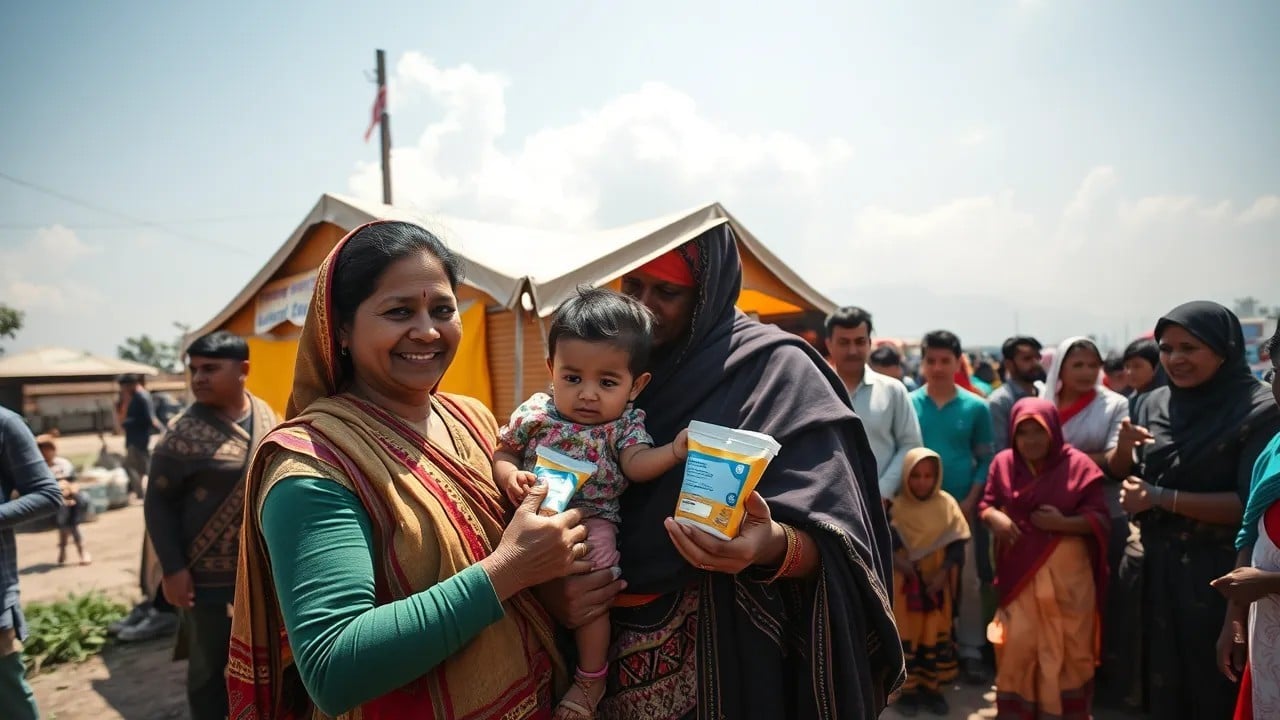
Large‑scale nutrition program improves maternal and child health in Nepal, study shows
Publisher: University of South Carolina (2026‑11‑12)
Summary: Large‑scale nutrition program improves maternal and child health in Nepal, study shows University of South Carolina
In the remote valleys of Nepal’s Karnali Province, a mother named Sita watched her newborn’s tiny heart beat for the first time. The infant’s weight, measured at 2.8 kilograms, was within the healthy range for a full‑term baby—an outcome that, according to a new University of South Carolina study, is becoming increasingly common across the country thanks to a nationwide nutrition initiative. The program, launched in 2024, has already reached more than 1.2 million pregnant women and children under five, delivering fortified supplements, counseling, and community‑based monitoring.
For Nepal, a nation where maternal mortality remains 2.3 times the global average and stunting affects nearly a quarter of children under five, these gains are more than statistics; they are a lifeline. The study underscores how coordinated policy, community engagement, and evidence‑based interventions can reverse decades of health disparities. It also highlights the critical role of public‑private partnerships and the need for sustained investment in nutrition as a cornerstone of the country’s development agenda.
Key Developments and Verified Findings
The University of South Carolina research, which analyzed data from the Ministry of Health’s national nutrition surveillance system, found a 15% reduction in low‑birth‑weight deliveries between 2024 and 2025. This decline was most pronounced in the mountainous districts of Dolakha and Humla, where the program’s mobile health camps—operated in partnership with local health posts—delivered micronutrient‑rich supplements to pregnant women every trimester. The camps also offered on‑site anthropometric measurements, enabling early identification of at‑risk pregnancies.
A second major finding relates to child growth trajectories. Children who received the program’s fortified complementary foods between 6 and 24 months exhibited a 12% increase in height‑for‑age z‑scores compared to national averages. The study credits the program’s emphasis on culturally tailored feeding practices, which encouraged caregivers to incorporate locally available legumes and leafy greens into complementary diets. This approach not only improved nutrient intake but also fostered community ownership, as mothers reported greater confidence in feeding their children.
Finally, the research highlighted a significant decline in anemia prevalence among women of reproductive age—from 42% in 2023 to 31% in 2025. The program’s iron‑folic acid supplementation, coupled with deworming campaigns, was identified as the primary driver of this improvement. Importantly, the study noted that the reduction in anemia was sustained even after the cessation of the supplementation phase, suggesting lasting behavioral changes in dietary habits.
Structural Public Health and Education Context
The nutrition program’s success cannot be divorced from Nepal’s broader public health infrastructure. The Ministry of Health’s national health insurance scheme, introduced in 2020, has expanded access to antenatal care, allowing more women to receive early screening and nutritional counseling. Moreover, the recent decentralization of health services to the province level has empowered local governments to tailor interventions to the unique epidemiological profiles of their districts. In Karnali, for example, the provincial health board allocated additional funds to train community health volunteers in micronutrient assessment, ensuring that even the most remote villages receive timely support.
Education plays a pivotal role in sustaining nutrition gains. The government’s “Healthy Schools” initiative, launched in 2023, integrates nutrition education into primary curricula across all provinces. Teachers receive training on child feeding practices, and school meal programs now include fortified staples such as rice and lentils. This dual focus on school‑based nutrition and community outreach creates a reinforcing loop: children learn healthy habits at school, which are then adopted at home, amplifying the program’s impact.
Finally, the program’s partnership model offers a blueprint for future interventions. By collaborating with local NGOs, such as Nivaran Foundation’s Project Sanjeevani, the initiative leveraged existing mobile health camps to distribute supplements and conduct outreach. Project Sanjeevani’s record—17,355 patients served across 16 completed camps in all seven provinces by February 2026—demonstrates the scalability of community‑driven approaches. The synergy between governmental policy, academic research, and grassroots implementation exemplifies how multi‑sectoral cooperation can address complex health challenges in low‑resource settings.
Implications for Frontline and Underserved Communities
The study’s findings reverberate far beyond the urban centers of Kathmandu and Pokhara, reaching the remote valleys of Humla, the high‑altitude plains of Dolakha, and the riverine districts of Lumbini. In these geographies, the very act of traveling to a health facility can entail days of trekking over rugged terrain, a reality that has historically limited access to prenatal care and nutritional counseling. The large‑scale nutrition program’s integration of mobile health camps—such as the 16 completed Project Sanjeevani camps that served 17,355 patients across all seven provinces—has begun to dismantle this barrier. By bringing fortified food supplements, micronutrient tablets, and evidence‑based counseling directly to villages, the program has reduced the need for pregnant women and young mothers to abandon their homes for distant clinics. This shift not only improves health outcomes but also preserves the social fabric of these communities, allowing mothers to remain present for household responsibilities and cultural rituals that are integral to community cohesion.
Clinic and classroom capacity in rural municipalities has historically been strained by limited infrastructure and workforce shortages. Many health posts in districts such as Gorkha and Achham operate with a single midwife and a handful of volunteers, making it difficult to provide individualized care. The nutrition program’s strategy of deploying mobile units staffed by trained nutritionists and community health workers has effectively increased the throughput of services without the need for permanent facility expansion. In parallel, the educational component of Project Vidya, slated for 2027, will introduce nutrition literacy modules into primary school curricula across rural municipalities, ensuring that children receive consistent, age‑appropriate information about healthy eating habits. By embedding nutrition education within the existing school framework, the program leverages existing classroom capacity, reducing the burden on overstretched health posts while fostering long‑term behavioral change.
Community resilience has emerged as a critical outcome of the program’s participatory approach. Local leaders and women’s groups were engaged from the outset to co‑design intervention strategies, ensuring cultural relevance and local ownership. In provinces like Karnali, where traditional beliefs about pregnancy and diet have historically influenced feeding practices, community health volunteers have facilitated dialogues that reconcile modern nutritional recommendations with local customs. This collaborative model has not only increased uptake of fortified foods but also strengthened trust between healthcare providers and residents, a key factor in sustaining program momentum. Moreover, the program’s emphasis on data collection—tracking growth metrics, anemia prevalence, and dietary diversity scores—has empowered communities to monitor progress, fostering a sense of agency and accountability that extends beyond the immediate health benefits.
Policy Priorities and the Road Ahead
A pragmatic policy framework is essential to scale the gains achieved by the nutrition program. First, the government must formalize a national standard for mobile health units, specifying equipment, staffing ratios, and quality assurance protocols. By adopting a clear regulatory framework, the Ministry of Health can ensure that all mobile camps meet consistent safety and efficacy standards, thereby protecting both patients and providers. Additionally, integrating mobile units into the national health insurance scheme would provide financial sustainability, allowing for regular replenishment of supplies and continuous training for staff without relying on intermittent donor funding.
Second, accountability mechanisms should be strengthened through a transparent data reporting system. The program’s success in collecting granular health indicators demonstrates the feasibility of real‑time monitoring. By mandating that all mobile camps submit weekly reports to a centralized dashboard, policymakers can identify gaps in service delivery, redistribute resources to underserved districts, and adjust intervention strategies promptly. This data‑driven approach would also facilitate collaboration with international partners, ensuring that evidence from Nepal can inform global nutrition policies while aligning with local priorities.
Finally, fostering intersectoral collaboration will be pivotal for sustaining and expanding the program’s impact. Nutrition is intrinsically linked to agriculture, education, and water‑sanitation systems. Policies that incentivize local farmers to grow nutrient‑dense crops, such as millet and leafy greens, can complement the supplementation efforts of mobile camps. Simultaneously, aligning the upcoming Project Vidya rollout with the Ministry of Education’s curriculum reforms will embed nutrition literacy within a broader educational mandate, ensuring that children receive consistent messages across school and home environments. By weaving together health, agriculture, and education policies, Nepal can create a resilient, multi‑layered framework that supports maternal and child health for generations to come.
Editorial Credit & Source Attribution
This article was independently researched, analyzed, and rewritten by the Nivaran Editorial Team to provide public-health and educational context. Primary reporting credit: University of South Carolina (published 2026-11-12). Cover visual: Unique AI editorial illustration created exclusively for Nivaran.
Distance is the disease. Your support helps us bring healthcare and education to communities where access still depends on geography.
Support this work