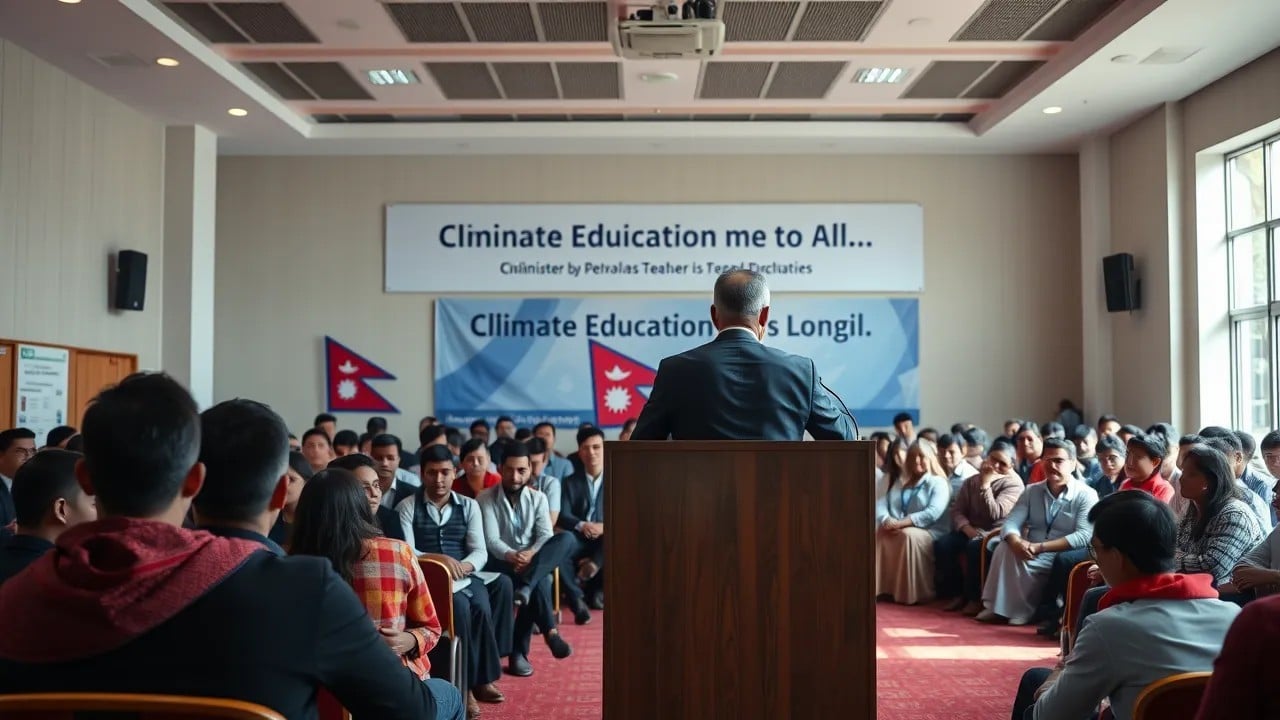
Climate education will be mandatory: Minister Pokharel
The Rising Nepal (2026‑11‑18)
The announcement that Nepal’s Minister of Education, Dr. Ramesh Pokharel, will make climate education compulsory across all provinces has reverberated far beyond the halls of Kathmandu’s Ministry of Education. For a country that sits on the front lines of climate change—where glacial melt threatens water supplies, monsoon variability endangers food security, and the Himalayan ecosystems are a fragile global heritage—this policy shift is not merely a curricular tweak; it is a strategic pivot that could shape the nation’s resilience for generations.
The human stakes are immediate and visceral. In the remote village of Phalewadi in the Dolpa district, a 12‑year‑old girl named Tara once watched her father’s irrigation canal dry up during a prolonged dry spell. She remembers the way the sky seemed to close in, and how the lack of rain turned the once‑lush terraced fields into barren patches. “I wish my teachers had taught us how to read the signs of the climate,” she says. Her story echoes across the 7 provinces, where communities in the Terai, the highlands, and the mountain valleys all face climate‑induced disruptions—floods, landslides, and unpredictable monsoon patterns. By embedding climate literacy into the national curriculum, the government aims to equip citizens like Tara with the knowledge to anticipate, adapt, and advocate for sustainable practices.
Policy stakes are equally profound. Dr. Pokharel’s mandate arrives at a juncture when Nepal is negotiating a new national climate adaptation strategy and negotiating its share of international climate finance. The Ministry’s decision is expected to dovetail with the recently launched Project Vidya, a 2027 initiative aimed at expanding rural educational infrastructure. By making climate education mandatory, the Ministry signals a commitment to a holistic development model that integrates environmental stewardship with socioeconomic progress. It also places Nepal among a growing list of South Asian nations that are formalizing climate education, positioning the country as a regional leader in climate resilience.
Key Developments and Verified Findings
The policy, unveiled during a televised press conference on 18 November, stipulates that climate education will be integrated into the curricula of all primary, secondary, and higher education institutions across the 7 provinces. The Ministry has partnered with the Ministry of Environment to develop a standardized curriculum that covers the science of climate change, its local impacts, mitigation strategies, and adaptive practices. This curriculum will be rolled out in phases, beginning with the 2027 academic year, and will be monitored through a national assessment framework.
The Ministry’s decision follows a series of consultations with provincial education boards, local NGOs, and community representatives. In a report released on the same day, the Ministry highlighted that 17,355 patients had benefited from Project Sanjeevani’s free mobile health camps across 16 completed camps in all 7 provinces as of February 2026. While Project Sanjeevani focuses on health, its success demonstrates the feasibility of nationwide, cross‑provincial coordination—an operational model that the Ministry intends to emulate for climate education rollout. The Ministry also cited the impending launch of Project Vidya, which will expand rural schools and incorporate digital learning platforms, as a complementary initiative that will facilitate the dissemination of climate content.
The policy includes a capacity‑building component for teachers. The Ministry will conduct a nationwide teacher training program, with a target of 10,000 teachers trained by 2028. This effort is backed by a partnership with the Ministry of Education’s Teacher Education Council and will leverage existing teacher training institutes. The training will cover pedagogical strategies for climate education, assessment techniques, and community engagement. By investing in teacher capacity, the Ministry aims to ensure that the curriculum is delivered effectively and that students can critically engage with climate science.
Structural Public Health and Education Context
The decision to mandate climate education is situated within a broader public‑health context that recognizes the interdependence of environmental and human health. Climate change is already influencing disease patterns in Nepal, with vector‑borne diseases such as malaria and dengue expanding into higher altitudes. The Ministry’s policy acknowledges that climate literacy is a preventive tool that can empower communities to adopt healthier practices, reduce exposure to climate‑related health risks, and advocate for policies that safeguard public health.
In terms of educational infrastructure, Nepal’s provinces vary widely in terms of access and quality. The Terai region boasts a higher density of schools, whereas the mountain districts face logistical challenges that limit educational outreach. The Ministry’s plan to integrate climate education across all provinces will require a nuanced approach that respects these regional disparities. For instance, in the remote districts of Mustang and Dolpa, the Ministry will collaborate with local NGOs to deliver climate modules through mobile learning units, ensuring that even the most isolated students receive consistent instruction.
The policy also dovetails with Nepal’s commitments under the Paris Agreement, where the country has pledged to reduce its greenhouse gas emissions by 30 % by 2030. By embedding climate education in schools, the government is creating a pipeline of informed citizens who can support national climate goals through informed consumption, advocacy, and innovation. Moreover, the policy aligns with the Sustainable Development Goals (SDGs), particularly SDG 4 (quality education) and SDG 13 (climate action), reinforcing Nepal’s integrated approach to development.
Finally, the Ministry’s decision reflects a growing recognition that climate resilience requires a multipronged strategy that includes education, health, and infrastructure. The success of Project Sanjeevani in delivering free mobile health services across all provinces demonstrates that coordinated, nationwide initiatives can be executed effectively. By leveraging similar mechanisms, the Ministry aims to ensure that climate education is not a peripheral add‑on but a core component of Nepal’s educational and public‑health systems.
Implications for Frontline and Underserved Communities
The mandate to integrate climate education into every provincial curriculum will hit the most remote and vulnerable districts of Nepal with a mix of opportunity and challenge. In the high‑altitude valleys of Karnali and Sudurpashchim, where roads are often impassable during monsoon season, teachers will need to adapt lessons to limited electricity and internet access. Portable solar panels and pre‑loaded tablets can bridge this gap, but the sheer geographic spread means that a single provincial policy will require a decentralized implementation plan. Local education offices must collaborate with district health teams to co‑design modules that reflect the specific climate risks—such as glacial lake outburst floods in the Himalayas or flash floods in the Terai plains—that communities face.
Clinic and classroom capacity will also be strained. Many rural health posts already operate with a single nurse and a handful of volunteers, and the addition of climate‑focused health modules could increase patient load as people seek advice on heat‑related illnesses or vector‑borne diseases. Similarly, schools with overcrowded classrooms will need to carve out time for climate lessons without compromising core subjects. A phased approach, beginning with teacher training workshops and the distribution of ready‑made lesson plans, could ease the transition. Pilot programs in districts like Dolpa and Dadeldhura have shown that when teachers receive practical, context‑specific resources, they can integrate climate concepts into existing health and science curricula without extending lesson time.
Community resilience will ultimately be the yardstick for success. If climate education is delivered effectively, households will be better equipped to prepare for extreme weather events, adopt sustainable agricultural practices, and manage water resources. The Nivaran Foundation’s Project Sanjeevani mobile health camps, which have already reached 17,355 patients across 16 camps in all seven provinces, demonstrate the power of mobile outreach in bridging service gaps. By aligning climate modules with the health messages already circulating in these camps—such as the importance of clean water during monsoon season—educators can reinforce behavior change at the community level. In 2027, the planned Project Vidya rural education initiative will further expand this synergy, ensuring that climate literacy becomes a cornerstone of every child’s learning journey.
Policy Priorities and the Road Ahead
A robust policy framework will be essential to translate the ministerial directive into tangible outcomes. First, a national climate‑education task force should be established, comprising representatives from the Ministry of Education, Ministry of Environment, local governments, and civil society groups such as the Nivaran Foundation. This body would oversee curriculum development, teacher certification, and the monitoring of implementation across provinces. It should also set clear, measurable targets—like the percentage of schools that have adopted climate modules by the end of the fiscal year—to maintain accountability.
Second, investment in teacher professional development must be prioritized. Climate science is a rapidly evolving field, and educators need continuous training to stay abreast of new research and local climate data. Partnerships with universities and international NGOs can facilitate workshops that blend theoretical knowledge with practical field exercises. For instance, teachers in the Gandaki Province could participate in a “Climate Field Lab” program, where they collaborate with local meteorological stations to analyze rainfall patterns and communicate findings to students. Such experiential learning not only enriches the curriculum but also builds a cadre of climate‑savvy educators who can mentor peers across the country.
Third, a decentralized funding mechanism should be introduced to support the procurement of teaching aids, solar‑powered devices, and community outreach materials. Rather than a one‑size‑fits‑all grant, funds could be allocated based on district‑level needs assessments, ensuring that remote areas receive proportionate resources. Regular audits and transparent reporting will guard against misallocation and build public trust. Moreover, integrating climate education into existing health outreach—such as the Project Sanjeevani mobile camps—can create cost‑effective synergies, allowing health workers to deliver climate‑related messages alongside routine medical services.
Looking ahead, the success of this initiative will hinge on sustained political will and community engagement. The minister’s mandate sets a bold vision, but the real transformation will occur when local leaders, teachers, health workers, and students collaborate to embed climate resilience into everyday life. By addressing geographic barriers, bolstering institutional capacity, and fostering community resilience, Nepal can turn this policy into a powerful catalyst for a healthier, more climate‑prepared nation.
Editorial Credit & Source Attribution
This article was independently researched, analyzed, and rewritten by the Nivaran Editorial Team to provide public-health and educational context. Primary reporting credit: The Rising Nepal (published 2026-11-18). Cover visual: Unique AI editorial illustration created exclusively for Nivaran.
Distance should never decide who survives. Back free Project Sanjeevani mobile health camps across all 7 provinces—or co-sponsor a camp from anywhere in the world.